- Steep drives wash out because water speeds up and carries the gravel with it. More gravel on top does not fix it.
- What holds: an uphill ditch, water bars that break the flow into short runs, rock outlets where the water leaves, crushed rock with fines over a solid base, and a check after every big storm.
- Fabric and clean rock do not help on their own. Water control does.
On this page
Why steep drives wash out
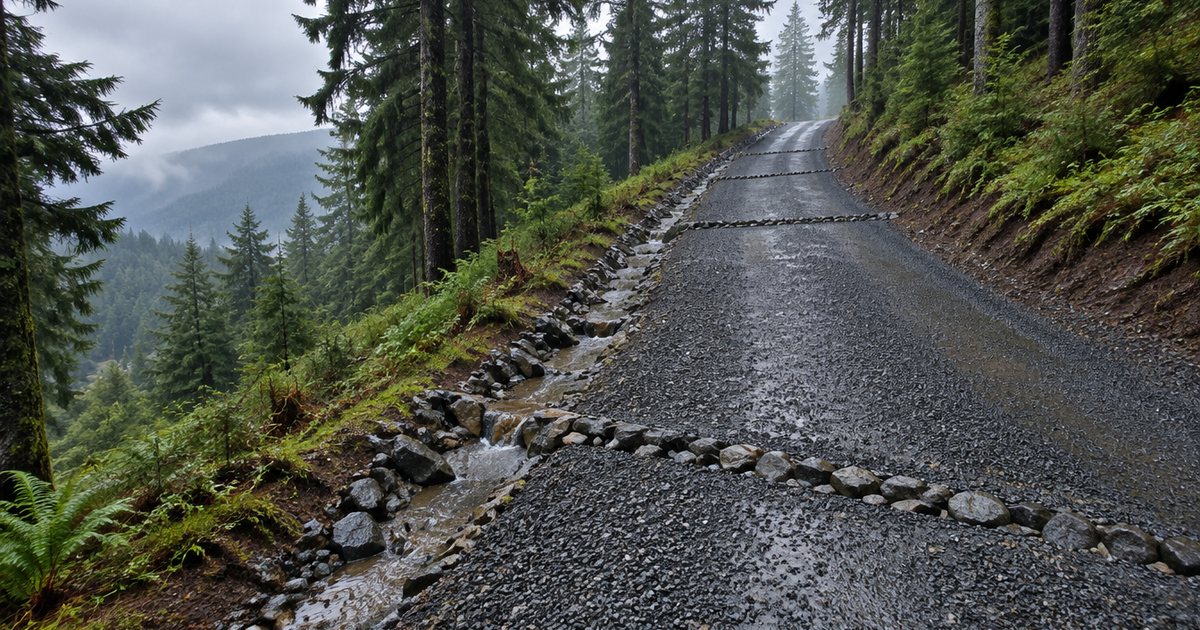
Water takes the steepest path, and on a steep drive that path is the drive. It speeds up as it goes, picks up the fines that hold the rock together, and leaves loose, rounded stones behind. Every rut becomes a channel for the next storm, so a small problem gets worse fast. A rut is a ditch you built by accident.
What actually holds
View from above. Uphill is at the top, downhill at the bottom.
- Uphill ditchcatches runoff from the hillside before it reaches the drive
- Water baran angled, packed hump that sends water off the side of the drive
- Rock outletwhere the water leaves, so it does not dig a gully
- Blue arrowsthe water path; the steeper the drive, the closer together the bars go
1. Keep hillside water off the drive
A ditch on the uphill side catches runoff before it reaches the surface. Where the ditch has to cross the drive, a pipe under it carries the water through.
2. Break the flow into short runs
Water bars, or rolling dips, are angled humps of packed rock or soil that send water off the side of the drive before it can build speed. The steeper the drive, the closer together they go. Where exactly depends on the slope and the soil, so it is best set by walking the drive in the rain, or just after.
3. Send the water somewhere that can take it
Water that leaves a bar onto bare soil digs a gully. A rock outlet or a vegetated area spreads it out and stops the damage from moving downhill.
4. Use rock that locks
Angular crushed rock with fines packs into a hard surface. A 3/4 minus top course over a 1-1/2 minus base is the valley standard. Clean rock and rounded stone roll like marbles on a slope. See 3/4 minus versus 3/4 clean. On soft ground, woven fabric under the base keeps the rock from sinking (more in gravel driveway sinking: what goes under it). Every size is in the rock and gravel size guide.
5. Shape the surface to shed water
On gentle drives a crown sends water off both sides. A steep or side-hill drive often works better with a light crown plus water bars, or a slight slope toward the downhill ditch. Which one suits yours depends on the drive.
What does not work
- Dumping more gravel on a washed-out drive. It washes the same way and buries the problem. Fix the water first.
- Clean or pea gravel on a slope. It rolls downhill.
- One water bar at the bottom. The water has already built speed by then.
- Filling ruts without rebuilding the shape. The next storm finds the same line.
- Fabric alone. Fabric keeps rock from sinking into soft ground. It does not stop water.
Keep it working
- Walk the drive after the first heavy rain of fall and after big storms.
- Check the bars, the ditch, any culvert and the outlets. Clear what is plugged.
- Fix small ruts early, before they become channels.
- Top up with a thin layer of 3/4 minus and regrade it in, every couple of years.
More on yearly upkeep in how to maintain a gravel driveway.
When gravel is not enough
On very steep drives even a well-built gravel surface needs more upkeep, and some owners choose chip seal, asphalt or concrete strips. We will tell you honestly what your drive can hold before you spend money on it.
What it costs
Driveway regrades start at $950 (see pricing), and repair on our jobs typically runs $950 to $3,200 depending on length and condition (see driveways). A steep drive that needs ditching, water bars or culvert work gets those items listed separately on the written quote.
Common questions
How far apart should water bars be?
There is no single number. They go closer together as the drive gets steeper and the soil gets softer. The right spacing is found by walking the drive in the rain and watching where the water speeds up.
What rock is best for a steep gravel driveway?
Angular crushed rock with fines: a 3/4 minus top course over a 1-1/2 minus base, compacted. Clean rock and rounded stone roll downhill.
Will landscape fabric stop my driveway from washing out?
No. Fabric keeps rock from sinking into soft ground. It does not stop water. Ditches, water bars, outlets and the shape of the surface do.
When is the best time to regrade a gravel driveway?
Usually when the ground is damp but not soaked. In the valley that is often early fall after the first rains, and again in spring. Very dry gravel will not bind, and saturated ground turns to mud under the machine.
Can a steep driveway be fixed without paving?
Often yes, if the water is controlled and the rock is right. Very steep drives still need more upkeep, and we will tell you honestly what yours can hold.
Drive washing out?
Send photos or call. We will walk it, tell you what is sending the water where, and price the fix in writing.