Gravel driveway sinking
or moving? What goes under it.
Iron & Earth Site Services · October 20, 2026 · 5 min read
If you keep adding gravel and it keeps disappearing, the problem is under the gravel, not on top of it. Here is how to tell what is going wrong and what a lasting fix includes.
- Gravel sinks when soft ground has nothing between it and the rock, so rock pushes down and clay pushes up.
- Gravel moves when the rock is rounded, too clean or too loose, or when water pushes it.
- More gravel on top only hides it for a season. A lasting fix is a solid base, fabric on soft ground, angular rock with fines, a crown and drainage.
On this page
Which problem do you have?
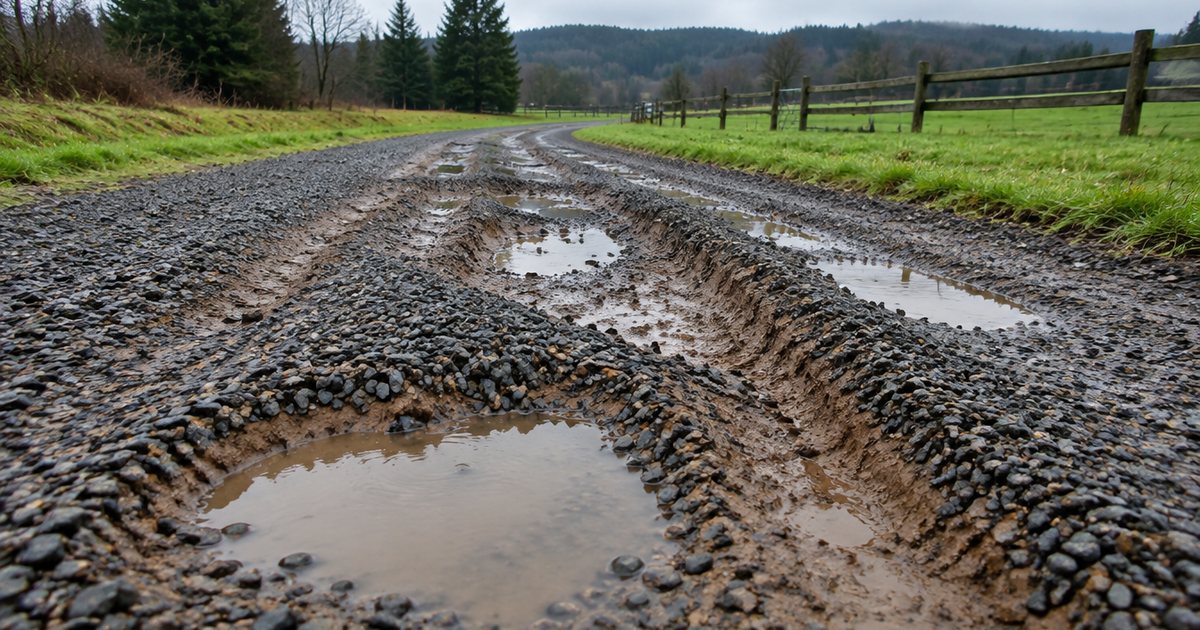
Ruts and soft spots that keep coming back
- Likely cause
- Soft ground under a thin base, or no base at all.
- The fix
- Dig out the soft spots, build a base (with fabric on wet ground), then re-top.
Gravel creeping to the edges or downhill
- Likely cause
- Rounded or clean rock, no crown, or a steep or turning section.
- The fix
- Angular crushed rock with fines, compacted, and a rebuilt crown.
The same potholes after every rain
- Likely cause
- Water standing in the low spot: no crown, or a plugged ditch or culvert.
- The fix
- Fix the water first, then the hole.
A thin, bony surface with weeds
- Likely cause
- The fines have washed away and the top rock is worn thin.
- The fix
- A top-up of 3/4 minus, regraded in.
Why gravel seems to disappear
Same clay, two builds. Left: thin gravel straight on clay. Right: fabric, base rock and top rock.
- Left: thin gravel on clayeach wheel pushes rock down and clay up, so the gravel keeps "disappearing" into mud
- Right: top rock, 2–3 inlocks together on the surface
- Right: base rock, 4–6 incompacted; spreads the load
- Right: woven fabricon soft or wet ground, keeps rock and clay apart
It usually has not gone anywhere. On valley clay, every wheel pushes rock down into soft ground and clay up into the rock. Over a season or two the stones sink and the drive turns into gravel-flecked mud. It looks fine until it does not, and then it is a rebuild.
What goes under gravel
From the bottom up:
- Stripped, shaped subgrade. Topsoil and sod removed, the soil shaped and compacted.
- Woven geotextile fabric on soft or wet ground, to keep the base from mixing into the soil.
- Base course. 4 to 6 inches of 1-1/2 minus or road base, compacted in layers.
- Top course. 2 to 3 inches of 3/4 minus.
- A crown of about 1/4 inch per foot, and a ditch and culvert kept clear.
About the fabric. Driveway fabric means woven geotextile sold for roads, not thin landscape fabric, which tears and bunches under traffic. Fabric separates rock from soil. It does not replace a base. The same layers keep paddocks and lanes firm: see mud-free paddocks and farm lanes.
Rock that stays put
“Minus” rock has fines, the small particles that lock the stones together when compacted. Clean rock and rounded stone behave like marbles, so they migrate. See 3/4 minus versus 3/4 clean, or the rock and gravel size guide to see every size next to a quarter.
Should you just add more gravel?
A thin top-up, about 1/2 to 1 inch of 3/4 minus regraded into the surface every couple of years, is normal upkeep. But if the drive sinks again after a top-up, more rock on top is not the fix. It sinks too. The soft spots need to be dug out and rebuilt with base, then topped. Dumping rock into low spots also tends to widen the puddle instead of fixing it.
Planning rock? Try the rock calculator for tons and yards, or measure the drive on a map.
What it costs
On our jobs, a top-up and regrade runs about $950 to $1,500 on a short drive and $1,800 to $3,200 on a longer one. A rescue, where the base has failed, typically runs $3,000 to $5,000 or more. Your drive’s length and soil change those numbers, so we write up a price after Jeff walks it. See our driveway work and pricing.
When to fix it
The best time is when the ground is damp but not soaked, which in the valley is usually early fall and spring. A drive that is failing in mid-winter may need a stopgap, such as filling the worst holes and clearing the ditch, until the ground firms up. If water is the real culprit, start with driveway washing out? what it means and how we fix it. On a steep drive, read what holds on a steep gravel driveway.
Common questions
Why does my gravel driveway keep sinking?
Usually the ground under it is soft clay with a thin base or none. Each wheel pushes the rock down and the clay up, and the gravel mixes into mud. The soft spots need to be rebuilt with a base, and fabric on wet ground, before new rock will stay.
Do I need fabric under a gravel driveway?
On soft, clay or wet ground, yes: woven geotextile keeps the base from mixing into the soil. On firm, well-drained ground it is optional insurance. Thin landscape fabric is not a substitute.
How thick should a gravel driveway be?
About 6 to 9 inches in total on most valley drives: 4 to 6 inches of base and 2 to 3 inches of top rock, over a shaped, compacted subgrade.
How often should I add gravel to my driveway?
A thin top-up about every 2 to 3 years is normal for a well-built drive, depending on traffic and weather. A drive that needs rock every year has a base or drainage problem.
Why does gravel keep moving to the edges of my driveway?
Usually rounded or clean rock with no fines, a flat or dished surface with no crown, or a steep or turning section. Crushed rock with fines, compacted, and a rebuilt crown fix most of it.
Drive that will not stay put?
Send photos or call. We will walk it, find out what is going on under the rock, and price the fix in writing.