Driveway washing out?
Here’s what’s going on.
Iron & Earth Site Services · October 13, 2026 · 6 min read
Gravel piled at the low end. A trench down the middle. Potholes that come back every storm. A washout is your driveway telling you where the water wants to go, and no amount of dumping more rock on top will change its mind.
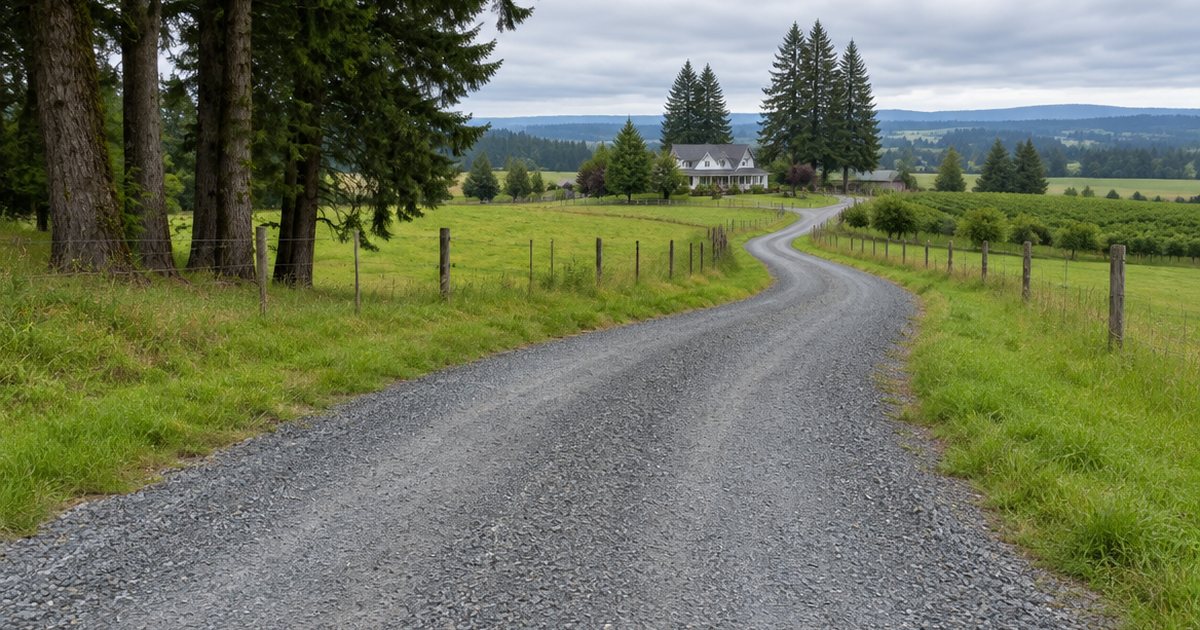
What a washout is telling you
Water takes the easiest path downhill. When a drive washes out, one of four things is usually giving it that path:
- No crown. A flat or dished surface carries water down the drive instead of shedding it off the sides.
- A plugged ditch or culvert. The water that should leave the property backs up onto the drive instead.
- Runoff from above. The road, a roof or a neighbor’s slope is sending water onto your drive.
- Rock that doesn’t lock. Clean, fines-free rock never packs together, so it washes out and migrates. (More on this in our rock and gravel size guide.)
Crown: about 1/4 in per foot. A 12 ft drive peaks about 1.5 in higher in the middle, so water sheds off both sides into the ditches. Layers, top to bottom:
- Top course3/4 minus, 2–3 in
- Base course1-1/2 minus, 4–6 in
- Woven fabricon soft or wet ground
- Ditch and runoffblue arrows show water leaving the crown; keep the ditch and culvert clear
What to do during the storm
You can’t fix a washout in the rain, but you can make the repair faster and cheaper:
- Stay off a saturated drive. Driving on it pushes wet gravel sideways and deepens the ruts.
- Take photos of where the water runs, where it pools, and where the rock ended up. Photos of the worst spot and the entrance help us the most.
- Watch where it goes. Note whether water comes from the road, a roof or uphill. That tells us where the real fix is.
What the permanent fix looks like
- Walk it end to end to find where the water comes from and where it needs to go.
- Fix the water first. That might be a cleaned ditch, a replaced culvert, or a regraded entrance so road runoff goes where it should.
- Regrade and rebuild the crown with the box grader, about ¼ inch per foot from the center to the edges.
- Add the right rock. Where the base is gone, a coarse base (1-1/2 minus) goes down first, then a 3/4 minus cap that locks into a firm surface. Rock with fines is the point; clean rock will wash out again.
- Walk it together at the end: crown visible, edges feathered, rock locked.
On steep drives, we may also add a diversion across the surface to turn water off before it builds speed.
When to schedule it
Heavy equipment on saturated clay can do more harm than good, so major regrades wait for a drier spell. That doesn’t mean waiting for summer: valley winters usually include dry stretches, and drainage and ditch work can often go ahead sooner. We’ll tell you honestly what can be done now and what saves money by waiting. Our dirt-work calendar has the month-by-month view.
Where to go next
If the water comes from the road or your entrance, read why your driveway floods every winter. For long-term care, see how to maintain a gravel driveway in the Willamette Valley. To figure out how much rock a repair needs, use our rock and gravel calculator. Details on the work are on our driveway service page, and pricing is on our pricing page.
Drive washing out?
Send a photo from the entrance and one from the worst spot. We’ll tell you what we see.