Every rock size,
measured against a quarter.
"Gravel" can mean anything from sand-sized chips to fist-sized rock. So on this page every size is compared to something you already have in your pocket: a US quarter, just under 1 inch across (0.955"). If you can picture a quarter, you can picture what will show up in the truck.
The most common rock problem isn't bad rock. It's a customer and a crew picturing two different rocks under the same name. Use this guide before you call, and we'll use the same names and sizes when we quote your job.
How to read a rock size
Three things decide how a rock behaves: its top size, whether it has fines (sand and dust), and whether it's crushed or round.
"Minus" means it includes everything smaller. "3/4 minus" (also written 3/4"-0) has rock up to 3/4" plus all the smaller pieces down to dust. The fines fill the gaps, so it packs down hard like a road. This is what most driveways and pads are built from.
"Clean" or "drain rock" means the fines are screened out. "3/4 to 1-1/2 drain rock" is only pieces between those two sizes. Water runs straight through it, and it never packs. Great in a French drain, bad underfoot.
Crushed rock locks; round rock rolls. Crushed rock has sharp, broken faces that wedge together. Pea gravel and river rock are tumbled smooth, so they shift like marbles under hooves, tires and boots.
Same number, very different rock. "3/4 minus" and "3/4 clean" are both called "three-quarter rock" on the phone. One makes a hard driveway; the other makes a loose, crunchy surface. Always say which one.
National codes vs. local names. Big online suppliers often use numbered codes like #57 or #4, and some describe their "driveway gravel" as clean stone with the fines screened out. Willamette Valley quarries mostly sell by inch size and "minus." We quote in local terms, and we'll tell you if a name you've seen online means something different.
Quick reference: every material vs. a quarter
A quarter is 0.955" across. Sizes below are the largest pieces in the load.
| Material | Top size & vs. a quarter | Type | Best for |
|---|---|---|---|
| 1/4 minusAlso called: Crusher fines, chip minus | 1/4"About a quarter of a quarter (pencil eraser) | Crushed, with fines | Paths, under pavers, horse-paddock top layer |
| 3/8 minusAlso called: Fine minus | 3/8"About 1/3 of a quarter | Crushed, with fines | Horse-paddock top layer, walkways |
| 3/8 chipsAlso called: Clean chips | 3/8"About 1/3 of a quarter, no dust | Crushed, clean | Pipe bedding, decorative, chip seal |
| Pea gravelAlso called: Pea rock | 3/8"About 1/3 of a quarter, smooth | Round, clean | Play areas, decorative beds, dog runs |
| 5/8 minusAlso called: Five-eighths minus | 5/8"About 2/3 of a quarter | Crushed, with fines | Horse paddocks, sacrifice areas, path surface |
| 3/4 minusAlso called: 3/4"-0 | 3/4"A bit smaller than a quarter | Crushed, with fines | Driveway top coat, shop pads, under slabs |
| 3/4 cleanAlso called: 3/4 washed, 3/4 gravel, #57 (close, but #57 runs a little bigger) | 3/4"About 1/2" to 3/4": a bit smaller than a quarter, no dust | Crushed, clean | French drains, drain fields, decorative beds |
| 1-1/4 or 1-1/2 minusAlso called: Road base | 1-1/2"Up to 1-1/2 quarters | Crushed, with fines | Driveway and pad base layer |
| 3/4 to 1-1/2 drain rockAlso called: Clean drain rock | 1-1/2"Just under 1 to 1-1/2 quarters | Crushed, clean | French drains, behind retaining walls, footing drains |
| 2 minusAlso called: Two-inch minus | 2"2 quarters side by side | Crushed, with fines | Heavy-use base, farm roads |
| 3 or 4 minusAlso called: Ballast | 3"-4"3-4 quarters in a row (about a fist) | Crushed, with fines | Soft-ground base, farm roads |
| Quarry spallsAlso called: Spalls | 4"-8"4-8 quarters in a row (softball to football) | Crushed, clean | Construction entrances, mud stabilization |
| River rockAlso called: Cobble | 1"-3"1-3 quarters, smooth | Round, clean | Landscaping, dry creek beds |
| RiprapAlso called: Rip rap | 12"+Basketball-sized and up | Crushed, clean | Ditch and bank erosion control |
| Pit runAlso called: Bank run | VariesSand up to fist-sized, unscreened | Mixed, with fines | Bulk fill under a rock cap |
| Fill dirtAlso called: Native fill | No rock sizeSold by the yard or ton | Soil | Raising grade, backfill |
| TopsoilAlso called: Screened topsoil | No rock sizeSold by the yard or ton | Soil | Lawns, gardens, final grade |
Moved here from somewhere else? A translation key
Rock names aren't national. Each state's DOT and each local quarry names things its own way, so the rock you ordered back home may go by a different name here. This key lists the closest local equivalents. Treat it as a starting point: it's a rough match, not a spec.
| If you called it | Common in | Closest here | Note |
|---|---|---|---|
| Crusher run, crush-n-run, quarry process (QP), road bond | East Coast, Southeast, Midwest | 3/4 minus or 1-1/2 minus (road base) | Same idea: crushed rock with the fines left in. Ask for the top size, since crusher run comes in several. |
| DGA, GAB, ABC stone | Northeast (DGA), Southeast (ABC) | 3/4 minus or 1-1/2 minus | Dense-graded base rock. Names are really specs, so top size varies. |
| CA6, 21AA, Class 5, 411, 2A Modified, Item 4 | IL, MI, MN, PA, NY, other states | 3/4 minus or 1-1/2 minus | Each state numbers its own base rock. Tell us the number and what you built with it, and we'll match it. |
| Flex base, limerock base | Texas and Southwest, Florida | 1-1/2 minus (road base) | Closest equivalent only. Limerock is a Florida material and isn't sold here. |
| #57 stone, clean stone, washed stone | East and Midwest | 3/4 clean | #57 runs a little bigger (up to about 1"). For drains, either works; for driveways, neither. |
| Stone dust, screenings, rock dust, blue chip | East and Midwest | 1/4 minus (crusher fines) | Crushed rock fines. Great paver base, too fine for a driveway on its own. |
| Decomposed granite (DG) | California, Southwest | 1/4 minus or 3/8 minus | Similar to walk on, but DG is granite and valley rock is mostly basalt, so color and look differ. |
| Bank run, run-of-bank, gravel fill | Many regions | Pit run | Unscreened, sand up to cobble. |
| Granular A, Type 1 | Canada, UK | 3/4 minus | Similar compactable base. Confirm top size. |
| "Gravel" (meaning rounded river stone) | Many regions | River rock or pea gravel | Here, "gravel" on the phone usually means crushed rock. Say crushed or round. |
The easy test: does it have fines or not? Almost every name that means a compactable base is "minus" rock with fines. Names for open, clean stone (like #57) are drain rock. If you're not sure what your old name means, tell us what you built with it and what you want now, and we'll name the right rock in writing.
3/4 minus vs. 3/4 clean: the one that trips people up
Both are crushed rock, both top out around 3/4", and on the phone both get called "three-quarter rock." The difference is the dust.
| 3/4 minus | 3/4 clean | |
|---|---|---|
| What's in it | Everything from dust up to 3/4" | Mostly pieces close to 3/4", fines washed or screened out |
| When compacted | The fines fill the gaps and bind it into a firm surface | Stays loose; the pieces never lock together |
| Water | Sheds off a crowned surface, but drains slowly through | Passes straight through; roughly a third of the pile is open space |
| Use it for | Driveway top coat, pads, paver and patio bases, walkways | French drains, footing drains, septic drain fields, decorative beds |
| Wrong choice looks like | A French drain that holds water instead of moving it | A driveway or paddock that shifts, ruts and migrates |
Septic drain fields have their own specs, so follow your designer's or installer's rock requirement. If a quote just says "3/4 gravel," ask which one.
Material by material
Crushed rock with fines ("minus"): packs hard
1/4 and 3/8 minus. Largest pieces are about a third of a quarter, mixed with sand and dust. Packs smooth and firm but stays a little forgiving underfoot.
- walkways, paver base, horse-paddock top layer.
- driveways on their own; too fine to carry truck weight.
5/8 minus. Largest pieces are about two-thirds of a quarter. It's the go-to Northwest footing for horse sacrifice areas because it packs tight and drains.
- paddocks, gate areas, garden paths, top coat on light-use lanes.
- the bottom layer over soft mud; it needs a coarser base under it.
3/4 minus. Largest pieces are a bit smaller than a quarter. The workhorse driveway and pad rock in the valley.
- driveway top coat, shop and RV pads, under concrete slabs.
- horse footing if you want something softer; it gets very hard.
1-1/4 to 1-1/2 minus (road base). Up to one and a half quarters. Goes down first, 4-6" thick, then gets a 3/4 minus cap.
- driveway and pad base, farm lanes.
- a finished surface people walk or ride on; the big pieces roll.
2, 3 and 4 minus. From two quarters up to a fist. Bridges soft ground so finer rock on top doesn't sink.
- wet sites, new roads on clay, heavy equipment areas.
- anywhere an animal or person stands without a finer cap.
Clean rock (no fines): drains, never packs
3/8 chips. About a third of a quarter, dust washed out. Sharp and loose.
- pipe bedding, drainage around fixtures.
- driveways or paddocks; it stays loose and crunchy.
3/4 clean. Pieces about 1/2" to 3/4", a bit smaller than a quarter, with the dust washed out. Water goes straight through; it never packs.
- French drains, drain fields, decorative beds.
- driveways, pads or paddocks; it stays loose and shifts.
3/4 to 1-1/2 drain rock. Just under a quarter to one and a half quarters, all one size range. Water goes straight through.
- French drains, footing drains, behind retaining walls, under perforated pipe.
- any surface you drive, walk or keep animals on. It acts like a pile of loose marbles that hurts.
Round rock: pretty, but it rolls
Pea gravel. About a third of a quarter, tumbled smooth.
- play areas, decorative beds, dog runs, some horse owners' rolling areas.
- driveways, slopes, or as the only footing in a horse gate area; it shifts and won't firm up.
River rock (1-3"). One to three quarters, smooth.
- dry creek beds, landscape accents.
- walking or driving surfaces.
Large rock
Quarry spalls (4-8"). Softball to football size. Pushed into mud to make a working surface.
- construction entrances, muddy staging areas.
- finished surfaces; always cap it.
Riprap (12" and up). Basketball-sized and larger.
- ditch lining, creek banks, culvert outlets.
- anything else. Work near streams may need permits.
Fill and soil
Pit run. Unscreened rock straight from the pit, sand to cobble. Cheap bulk.
- raising grade under a rock cap.
- a finished surface; it has big rocks mixed in.
Fill dirt. Native soil, usually with clay. Has no rock size.
- backfill, raising low spots, berms.
- growing grass, or under a driveway without compaction and rock on top.
Topsoil. Screened soil for growing.
- lawns, gardens, the last few inches of final grade.
- structural fill; it settles.
Matching the material to your project
Whatever you're having delivered (rock, fill or soil), the same three questions decide what to order: What will stand, drive or drain on it? What's underneath, firm ground or soft Willamette Valley clay? And where does the water go? Here's how that plays out on the jobs we get asked about most. Scene images are AI-generated illustrations of typical projects, not photos of our jobs.
A driveway or farm lane
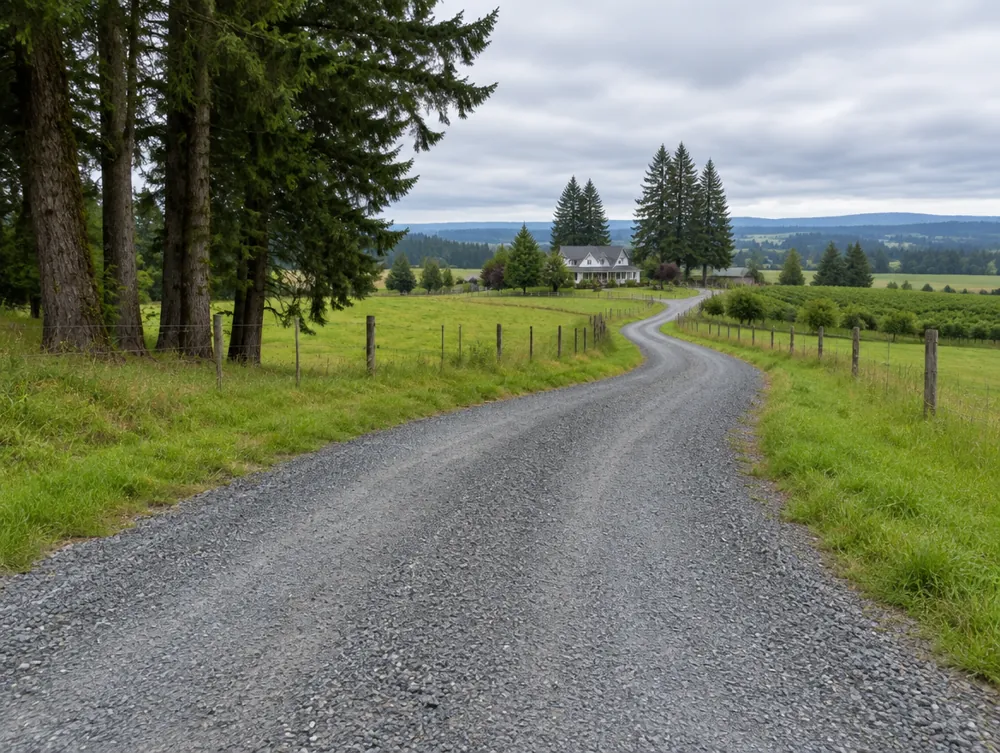
Two layers. A coarse base (1-1/2 minus, 4-6" deep, pieces up to about one and a half quarters) carries the weight. A 3/4 minus cap (2-3", a bit smaller than a quarter) locks into a firm, crowned surface. On clay or wet ground, woven fabric goes under both.
Common mix-up: a load of clean "3/4 gravel" with the fines screened out. It looks tidy but never locks, and it migrates into ruts within a season.
A shop, RV or equipment pad
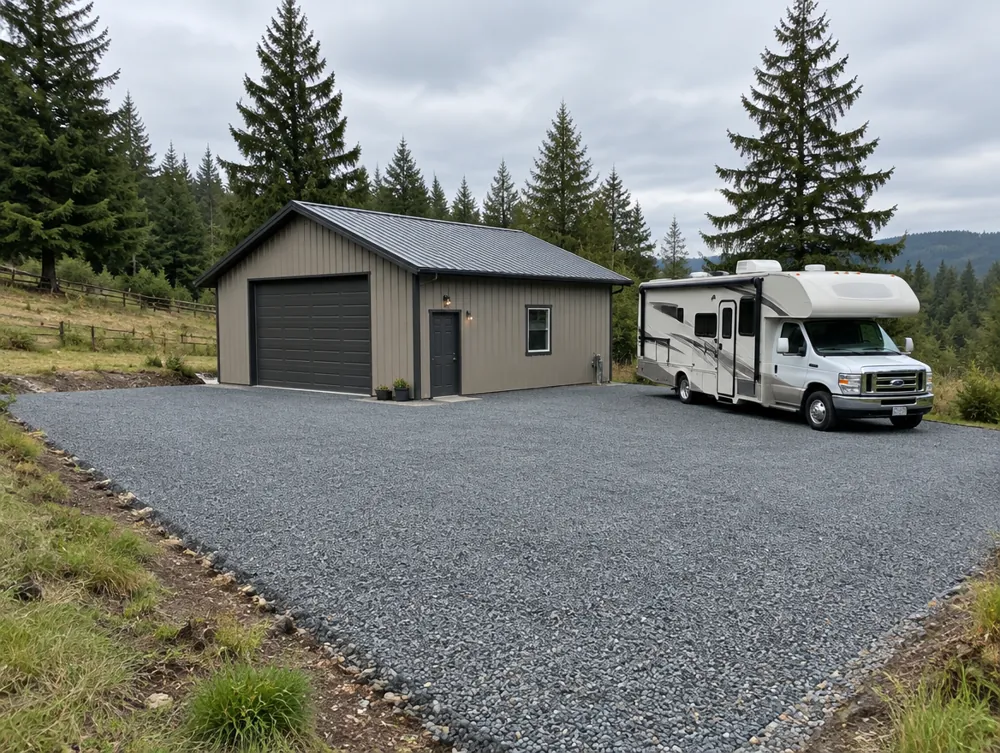
Same idea, built heavier: 1-1/2 or 2 minus, 6" or more, compacted in lifts, capped with compacted 3/4 minus. Round rock has no place here.
A horse paddock, sacrifice area or gate
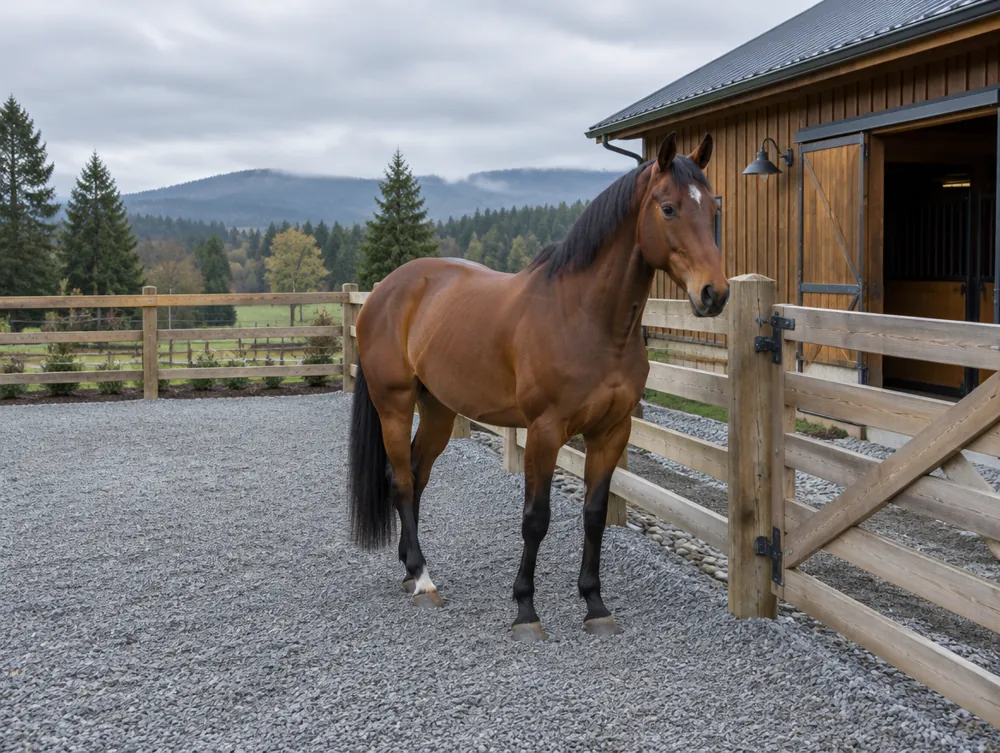
For a typical healthy horse, Northwest conservation districts recommend crushed rock with fines over road fabric, with 5/8 minus as the footing. Bottom to top:
- Grade the ground so water sheds away from the barn and gate.
- Woven geotextile (road fabric) keeps rock from sinking into clay.
- Base: 1-1/4 to 2 minus, about 4-6" deep, pieces up to one and a half to two quarters. The horse never sees it.
- Footing: 5/8 minus, compacted, pieces up to about two-thirds of a quarter. Snohomish Conservation District recommends at least 6" of footing.
- Optional softer top: 3/8 minus or a strip of pea gravel for rolling and lying down, kept away from feed areas.
As a rule of thumb, Snohomish Conservation District suggests at least 700 sq ft per average horse. 3/4 minus also works but packs harder; ask your farrier or vet if your horse has hoof issues.
Common mix-up: "gravel" that meant clean 3/4 drain rock, which stays loose and sharp under hooves, or the coarse base rock ending up on the surface.
A French drain or retaining-wall backfill
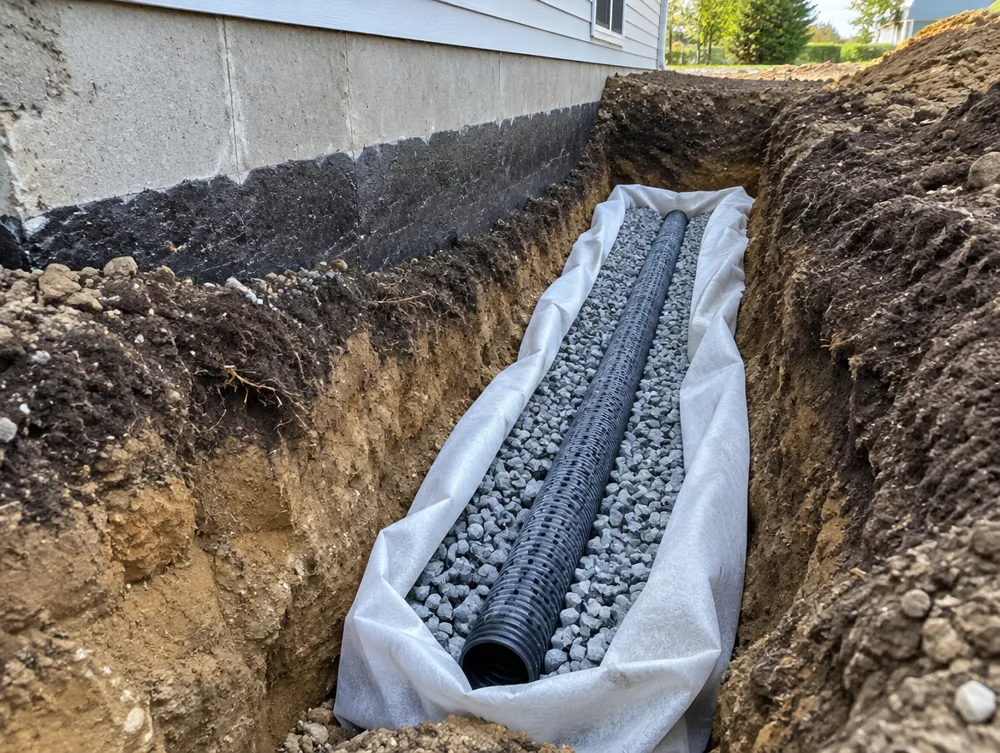
This is the one job where you want clean rock: 3/4 to 1-1/2 drain rock around perforated pipe, wrapped in non-woven fabric so soil can't clog it. Water has to pass through, and fines would plug it.
Common mix-up: ordering a "minus" rock because it was cheaper or "what the driveway used." The fines turn it into a dam.
A dog run, play area or garden path
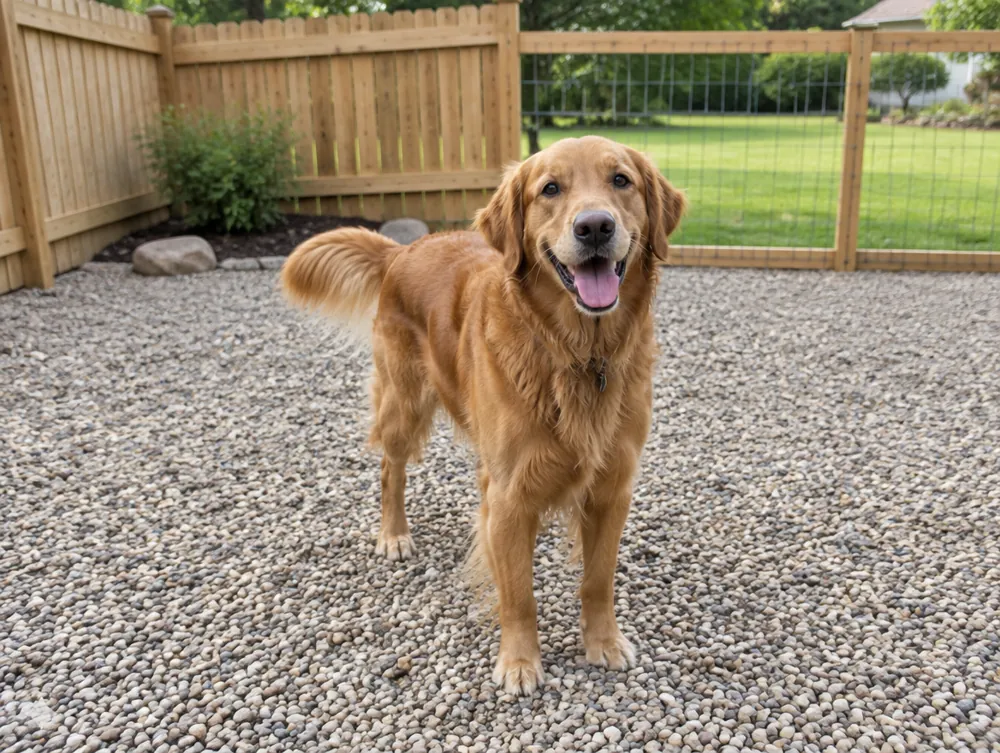
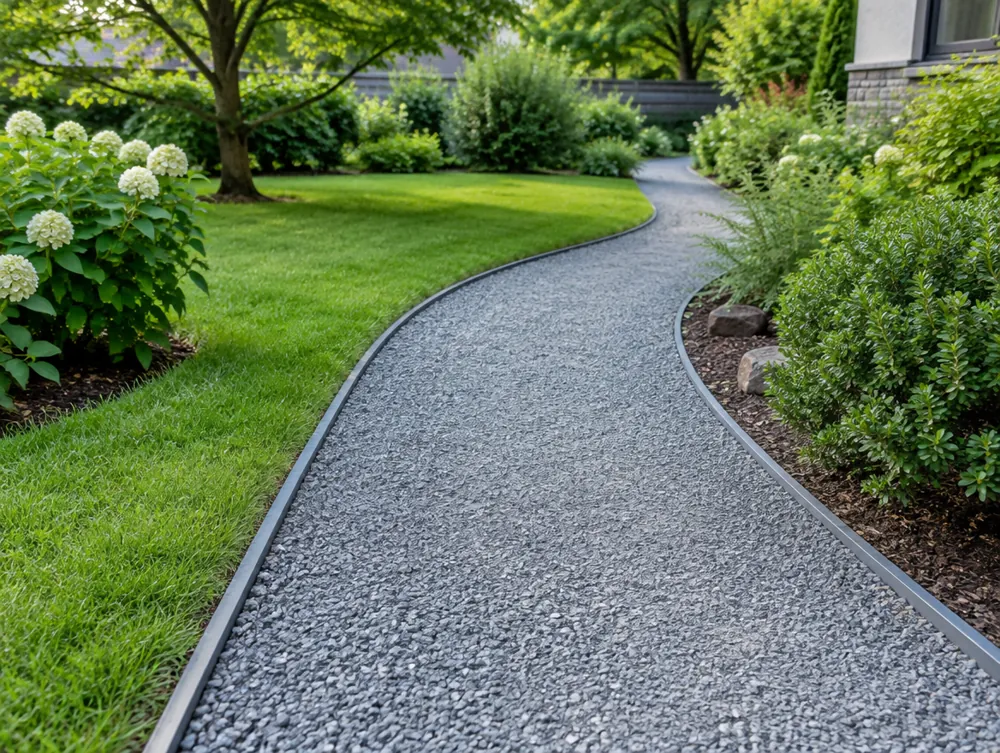
Pea gravel (about a third of a quarter, smooth) is comfortable for dog runs, play areas and decorative beds. For a walking path that should firm up, use 3/4 minus as a base with 1/4 or 3/8 minus on top. Keep pea gravel off slopes; it rolls downhill.
A muddy lane or construction entrance
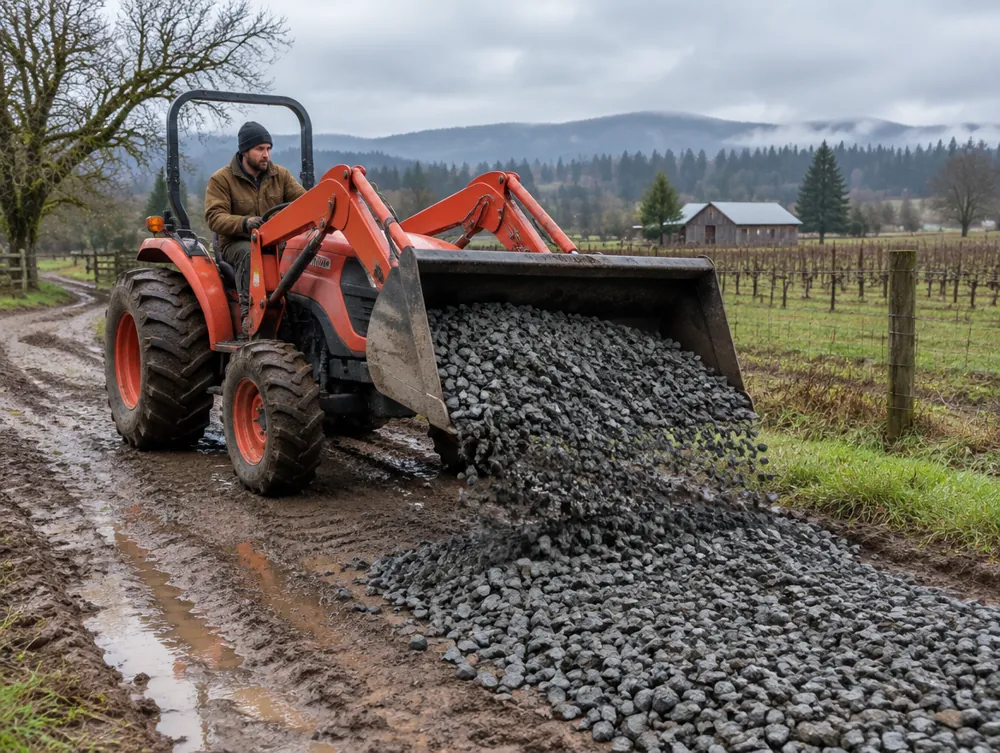
Soft ground needs a bridge: woven fabric, then 3-4 minus or quarry spalls (fist to football size), then a cap of 1-1/2 or 3/4 minus. Skip the cap and the big rock just rolls and gets pushed back into the mud.
Raising a low spot, or starting a lawn or garden
Fill dirt or pit run (unscreened rock, sand to cobble) is the cheap bulk layer for raising grade, compacted in lifts. Topsoil only goes on the last few inches. Topsoil settles, so it isn't structural fill, and fill dirt with clay is a poor place to grow grass.
A ditch, creek bank or culvert outlet
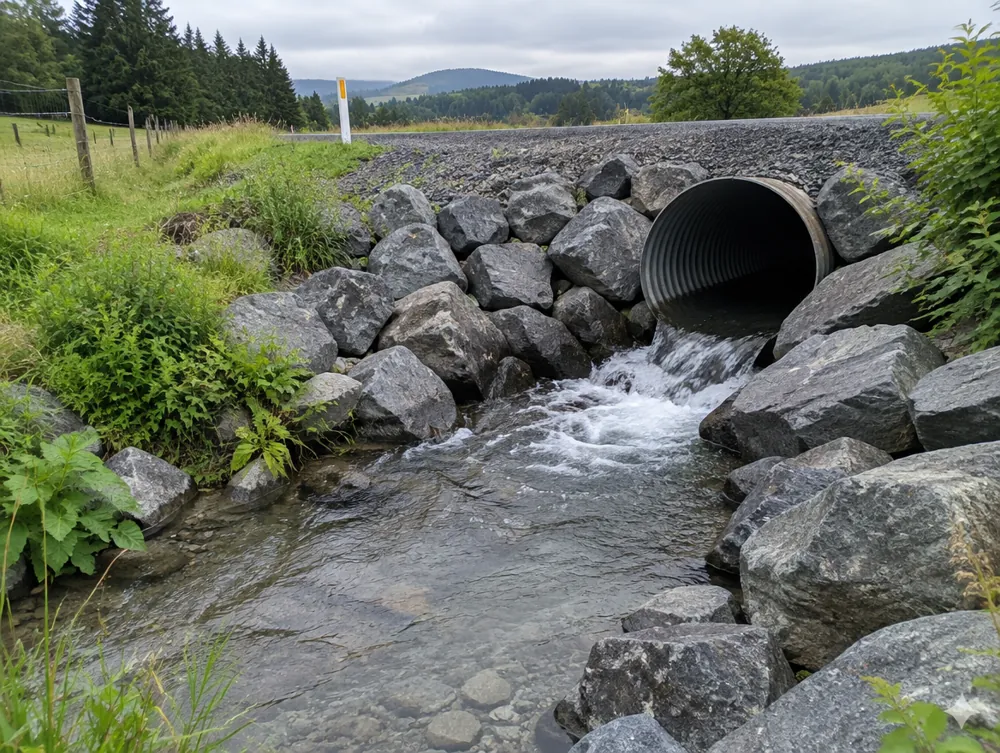
Riprap (12" and larger, basketball-sized and up) lines ditches and culvert outlets so moving water can't wash them out. Work near streams may need permits.
Paddock sources: Snohomish Conservation District: Heavy Use Areas · Pierce Conservation District: Gravel and Geotextile Footing · Northwest Horse Source: Gravel footing choices
Mix-ups we see on every kind of job
- "Gravel" meant clean rock. Clean rock drains but never packs. Anything you drive, walk or keep animals on needs rock with fines.
- The base became the surface. 1-1/2 minus or bigger is right underneath but too coarse on top.
- Round rock where it needs to firm up. Pea gravel and river rock roll, so skip them for driveways, pads and gateways.
- Same name, different rock. "3/4 minus" and "3/4 clean" are both "three-quarter rock" on the phone.
- Fill and topsoil swapped. One is structural, the other is for growing.
Common recipes at a glance
Most jobs use the same few layer combinations. Depths are typical starting points; soft or wet ground needs more.
| Project | Fabric | Base layer | Top layer | Avoid on top |
|---|---|---|---|---|
| Gravel driveway | Woven, on clay or wet ground | 1-1/2 minus, 4-6" (up to 1-1/2 quarters) | 3/4 minus, 2-3" (a bit smaller than a quarter) | Clean drain rock, pea gravel |
| Shop, RV or equipment pad | Woven | 1-1/2 or 2 minus, 6"+ | 3/4 minus, compacted | Round rock |
| Muddy farm lane or construction entrance | Woven | 3-4 minus or quarry spalls (fist to football) | 1-1/2 or 3/4 minus | Anything without fines |
| French drain | Non-woven, wrapped around the rock | Clean 3/4 to 1-1/2 drain rock around perforated pipe | Drain rock or topsoil and sod | Any "minus" rock (fines clog it) |
| Behind a retaining wall | Non-woven | Clean drain rock behind the wall | Soil cap | Fill dirt against the wall |
| Horse paddock | Woven | 1-1/4 to 2 minus, 4-6" | 5/8 minus, compacted | Clean drain rock, coarse base rock |
| Walkway | Optional | 3/4 minus, 3-4" | 1/4 or 3/8 minus | Pea gravel on slopes |
How to order so you get the rock you pictured
Tell us what the area is for, and we'll recommend the rock. Then we'll confirm it in writing using these four things:
- What it's for: driveway, paddock, drain, pad, path.
- Size in inches and "minus" or "clean": e.g., "5/8 minus," not just "gravel."
- Quarter check: "largest pieces about two-thirds of a quarter."
- Depth and area: e.g., "6 inches over 30 x 40 feet," so we can figure tons. Our rock and gravel calculator does the math.
Before the rock is spread, we'll show you a handful next to a quarter at the site. If it's not what you pictured, we stop and sort it out before it's on the ground.
Common questions
I moved here from another state. What do you call crusher run, #57 or DGA?
Crusher run, DGA, QP and most state base-rock numbers are crushed rock with fines, which we call 3/4 minus or 1-1/2 minus (road base). #57 is clean stone, closest to our 3/4 clean. See the translation key above, and tell us what you built with it so we can match it.
What does 3/4 minus mean?
It's crushed rock with pieces up to 3/4 inch plus all the smaller pieces down to dust. The fines fill the gaps so it packs down hard. It's the standard driveway top coat and pad rock in the valley.
How do I know which rock or fill I need?
Tell us what the area is for, what's underneath (firm ground or clay) and where the water goes. Surfaces you drive or walk on need rock with fines such as 3/4 minus; drains need clean drain rock; raising grade uses fill or pit run. We confirm the size in writing before delivery.
What rock is best for a horse paddock?
Crushed rock with fines over woven fabric, with 5/8 minus as the footing on a coarser 1-1/4 to 2 minus base. Avoid clean drain rock, which stays loose and sharp. Ask your farrier or vet if your horse has hoof issues.
What's the difference between drain rock and base rock?
Drain rock is clean (no fines), so water passes straight through and it never packs. Base rock is a "minus" product with fines, so it compacts into a firm layer. Drain rock goes in French drains; base rock goes under driveways and pads.
Related
Put the right rock to work.
Gravel Driveways
Crowned, compacted, culverted. Built with the right base and top course.
Service detailsDrainage
French drains, swales and culverts. Where clean drain rock earns its keep.
Service detailsDriveway Maintenance
What keeps a valley gravel drive alive for 20+ years.
ReadRock Calculator
Tons and cubic yards from length, width and depth.
Use the calculator3/4 Minus vs. 3/4 Clean
Why one word changes your project.
ReadMud-Free Paddocks
The layers that keep paddocks and lanes firm.
ReadNot sure which rock you need?
Tell us what the area is for. We'll recommend the rock and confirm the size in writing.