Driveway culverts:
size, permits, cost and who pays.
Iron & Earth Site Services · October 20, 2026 · 8 min read
A culvert is the pipe that keeps ditch water from taking over your driveway. Here is when you need one, how it is sized, who has to approve it, and who pays for it.
- You need a culvert where your driveway crosses a ditch or low spot that carries water.
- The agency that owns the road decides the permit and often the minimum pipe size. County, city and state each have their own office. Ask before you buy pipe.
- The driveway owner usually pays for the pipe under the drive and keeps it clear. The road agency usually keeps the road ditch. Your permit spells it out.
- We give a written, itemized price for the pipe, rock and labor once we see the site.
On this page
What a driveway culvert does
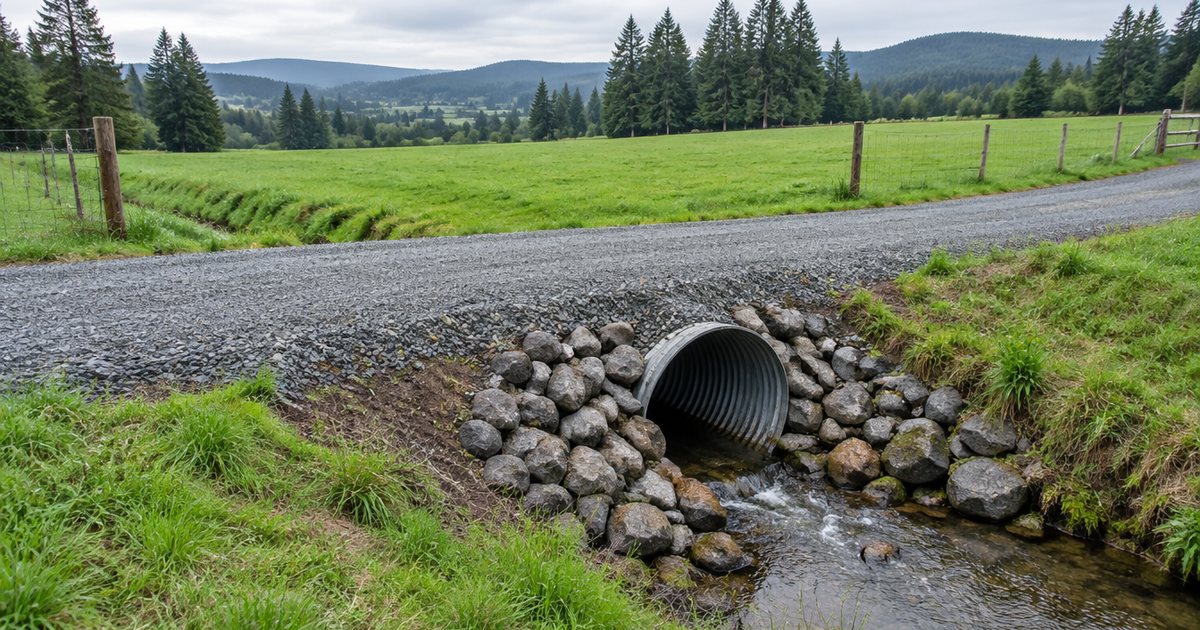
A culvert is a pipe under your driveway that lets the roadside ditch keep flowing. Without it, ditch water floods the drive or backs up onto the road. When the pipe plugs, crushes or is too small, the water takes the easy way out, and that is across your driveway.
Side view along the roadside ditch, left to right:
- Roadside ditchsteady fall toward the outlet; water flows left to right
- Drivewaycrosses over the pipe
- Culvert pipecarries ditch water under the drive to the other side
- Riprap at the outletstops the water digging a hole
- If silt and leaves plug the pipewater backs up and runs across the drive instead (red arrow)
Do you need one?
- Yes if the drive crosses a ditch, swale or low spot that carries water, even if it only runs in winter.
- Probably not if the drive runs beside the ditch, or the ground stays dry and water sheets off the road.
- Replace it if the pipe is crushed, rusted through, full of silt, or too small for the storms you see now.
- Stop and call first if the ditch is really a stream (it runs most of the year, or fish live in it). Different state rules apply. See the stream note below.
Permits: who owns the road decides
Connecting a driveway to a public road, or changing the connection, usually needs a permit from the agency that owns the road. Call them before you buy pipe or dig. Here is what we found:
County road
- Who
- Linn County Road Department, Albany. (541) 967-3919 (from the county form; call to confirm).
- What to expect
- An “Application for Right-of-Way Encroachment” for new or changed access. The form we found asked for proof of liability insurance, said review can take up to 30 days, and listed a $250 fee plus possible other fees. It was a 2021 version, so ask what applies now. The permit comes with drawings and conditions.
State highway
- Who
- ODOT, through your local district office. State highways in Linn County include US 20, OR 34 and OR 226.
- What to expect
- The state controls access to its highways, so a new or changed approach needs an approach road permit. ODOT offers an optional pre-application meeting.
City street
- Who
- Your city’s public works department.
- What to expect
- Work in the city right-of-way usually needs a permit. Ask before you dig.
Private road
- Who
- The road owner or the road association.
- What to expect
- Check the road agreement. Many have their own pipe and drainage rules.
Bring the address, the road name, a photo of the existing entrance and ditch, and which way the ditch flows.
If the ditch is really a stream
Many roadside ditches are not streams, but some are, or were. Oregon requires fish passage at culverts in waters where native migratory fish live or once lived, and work in streams and wetlands can need a state Removal-Fill permit from the Department of State Lands. If water runs most of the year, or the ditch joins a creek, ask before you dig. The Oregon Department of Fish and Wildlife and the Department of State Lands can tell you.
What size culvert do you need?
Looking along the pipe, from one side of the drive to the other:
- Driveway surfacecrowned so water sheds off both sides
- Cover over the pipeyour permit sets the minimum; often a foot or more
- Pipesized to the ditch, not guessed
- Bedding rockfirm, even support under and beside the pipe
- Side slopesthe pipe runs through them, so it is longer than the drive is wide
There is no one answer. The size depends on how much water the ditch carries in a big storm, how steep the ditch is, and what the road agency requires. Many agencies set a minimum diameter, and 12 to 18 inches is a common range. A ditch that drains a large area needs more.
Do not guess low. A pipe that is a little small plugs sooner and overflows in the storm that matters. A bigger pipe costs a little more up front and far less than a washed-out driveway.
Length. The pipe has to run through the sloped sides of the driveway, not just under the driving lanes, so it is longer than the drive is wide. Your permit drawing usually gives the length.
Material. Corrugated metal and heavy-duty plastic are both common. Metal is strong under load but can rust through over the years. Plastic does not rust but needs careful bedding and cover. The agency may name what it accepts.
What a proper install includes
- Set at the ditch’s flow line with a steady fall, so water runs through instead of sitting in the pipe.
- Firm bedding rock under and beside the pipe, placed and compacted evenly.
- Enough cover over the pipe, in compacted layers, so trucks do not crush it. Your permit sets the minimum. A foot or more is common.
- Rock at the inlet and outlet so the water does not scour out the ends.
- A crowned drive that sheds water into the ditch instead of onto the pipe ends.
Who pays, and who maintains it?
In most places the owner of the driveway pays for the culvert under it and keeps it clear. The road agency usually looks after the road ditch itself. Permit terms and local rules vary, so check yours. If a plugged culvert sends water onto a neighbor’s land or onto the road, it can become your problem, so it is worth keeping clear.
What does a culvert cost?
We do not quote a price from a blog post, because the same pipe can be a very different job from one driveway to the next. What moves the price:
- Pipe size, length and material
- How deep the ditch and the cover are, and how much digging that takes
- Rock for bedding and for the inlet and outlet
- Access and machine time
- Permit fees, and the insurance the agency asks for
Our drainage work starts at $1,200 for a single problem. Whether a culvert fits under that depends on the size and the site, so we write up an itemized price after we see it. See pricing.
Signs your culvert is failing
- Water standing in the ditch above the pipe after rain
- Water running across the driveway instead of through the pipe
- The driveway sinking, cracking or rutting over the pipe
- Rust holes, or a crushed or flattened pipe end
- Gravel washing away, or a hole forming at the pipe ends
- A ditch that no longer has a clear fall to the pipe
Keeping it working
Walk the ditch after the first big rain of fall. Clear leaves, silt and grass from the inlet, and check the outlet for scour. If the pipe is full of silt, it needs to be cleaned out. More in clearing ditches and culverts before the storms. If water floods the drive in storms, read why your driveway floods every winter. For the other drainage tools, see French drain, swale, ditch or culvert.
Common questions
Who is responsible for a driveway culvert?
Usually the owner of the driveway pays for the pipe under it and keeps it clear, and the road agency looks after the road ditch. The terms of your permit and local rules decide, so ask the county, city or state office that owns the road.
Do I need a permit for a driveway culvert in Linn County?
If your driveway connects to a county road, the Linn County Road Department takes an application for right-of-way work and may set the pipe size and cover. State highways go through ODOT and city streets through the city. Call the agency that owns your road before you start.
What size culvert do I need for my driveway?
It depends on how much water the ditch carries and on the road agency’s minimum. 12 to 18 inches is a common range, and a ditch that drains a large area needs more. Ask the agency, and do not guess low.
How long should a driveway culvert be?
Long enough to run through the sloped sides of the driveway, so longer than the drive is wide. Your permit drawing usually gives the length.
Why is my driveway sinking over the culvert?
Usually the pipe is crushed, the cover is too thin, or water is washing soil out around the pipe. It needs to be dug up and checked before the hole grows or the pipe fails.
Sources
Checked October 20, 2026. Rules and phone numbers change, so confirm with the agency before you act.
Culvert plugged or crushed?
Send a photo of the pipe and the ditch. We will tell you what we see and price the fix in writing.