Mud-free paddocks
and farm lanes.
Iron & Earth Site Services · October 13, 2026 · 7 min read
Valley clay holds water, and animals, trucks and tractors turn wet clay into soup. A paddock or lane that stays firm all winter isn’t a matter of luck or expensive rock. It’s layers, drainage and ordering the right size.
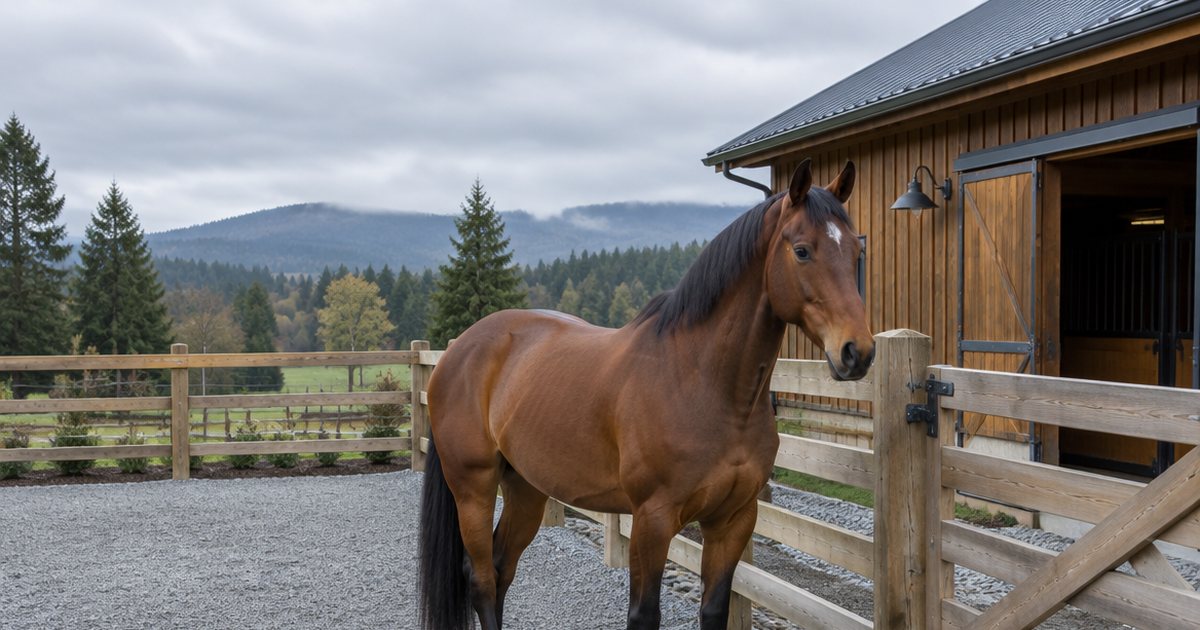
Why paddocks and lanes turn to mud
Three things combine: traffic concentrated at gates, waterers and feeders; clay that holds water instead of draining it; and no base to carry the load. Add roof runoff pouring into the same spot, and the ground has nowhere to go but soft.
The layers that hold
The usual recipe for a heavy-use area, bottom to top:
- Grade the ground so water sheds away from the barn, gate and waterer.
- Woven geotextile (road fabric). Keeps rock from sinking into the clay.
- Base: 1-1/4 to 2 minus, about 4-6” deep. Pieces up to one and a half to two quarters across. The animals never see it.
- Footing: 5/8 minus, compacted, with pieces up to about two-thirds of a quarter. Northwest conservation districts generally recommend crushed rock with fines for footing.
Every size here is explained, with the quarter comparison, in our rock and gravel size guide.
Grade the ground so water sheds away from the barn and gate. Layers, top to bottom:
- Footing: 5/8 minuscompacted, at least 6 in; pieces about 2/3 of a quarter
- Base: 1-1/4 to 2 minus4 to 6 in deep; pieces up to 1½–2 quarters
- Woven geotextilekeeps rock out of the clay
- Native clayvalley clay holds water
Start with the worst spots
If budget is tight, don’t rock the whole paddock. Gates, waterers, feeders and the path between them take the most abuse, so those areas get the full treatment first. The rest can follow later.
Deal with the water too
- Gutters and downspouts on the barn, routed away from the paddock.
- Grading so water leaves instead of ponding.
- A swale or French drain above the area if hillside water runs through it. See which drainage fix fits your problem.
Farm lanes and gateways
The same logic applies at a smaller scale: fabric on soft ground, coarse base, then a cap with fines so it packs. Skip the cap and the big rock rolls and gets pushed back into the mud.
Mistakes that bring the mud back
- Clean “3/4 gravel.” It drains but never packs, and it stays sharp and loose underfoot. Surfaces animals stand on need rock with fines.
- The base became the surface. 1-1/2 minus or bigger is right underneath, but too coarse on top.
- Pea gravel everywhere. It’s comfortable to lie on, but it won’t firm up in gateways and high-traffic lanes.
- No fabric. Without it, rock sinks into valley clay within a season or two.
How much rock?
The guideline we see cited most is at least 700 square feet per average horse for the whole area, but your layout matters more than any rule of thumb. Once you know the area and depth, our rock and gravel calculator converts it to cubic yards and tons.
What helps us quote it
A rough sketch or a few photos, the size of the area, where the animals spend most of their time, and where the water goes. We’ll walk it, recommend the rock, and put the size and type in writing so there’s no guessing about what shows up.
Paddock or lane turning to mud?
Send a photo and the rough size. We’ll recommend the layers and the rock.