French drain, swale, ditch, or culvert?
A drainage decision guide.
By Jeff Walters · April 28, 2026 · 8 min read
Four common drainage tools, four different problems they solve. Most rural property owners assume "drainage" means one thing — usually a French drain. But picking the wrong tool for the wrong problem is how a $3,000 fix becomes a $7,000 fix that doesn't actually fix anything. Here's the decision guide.
Surface water vs. groundwater — the first split
Before picking a drainage tool, identify which kind of water is causing the problem:
- Surface water moves on top of the ground. You can see it during a storm — sheet flow across pasture, water running down a slope, runoff from a roof or driveway. It pools where the surface dips and dies where the surface drops to a discharge.
- Groundwater moves under the surface, through saturated soil. You can't see it but you can feel its effects — soggy ground in summer, springs that keep flowing after rain has stopped, basements and crawlspaces that stay damp.
Different tools solve different problems. Trying to fix groundwater with a swale doesn't work. Trying to fix surface water with a French drain wastes money on capacity you don't need.
The swale: surface water's friend
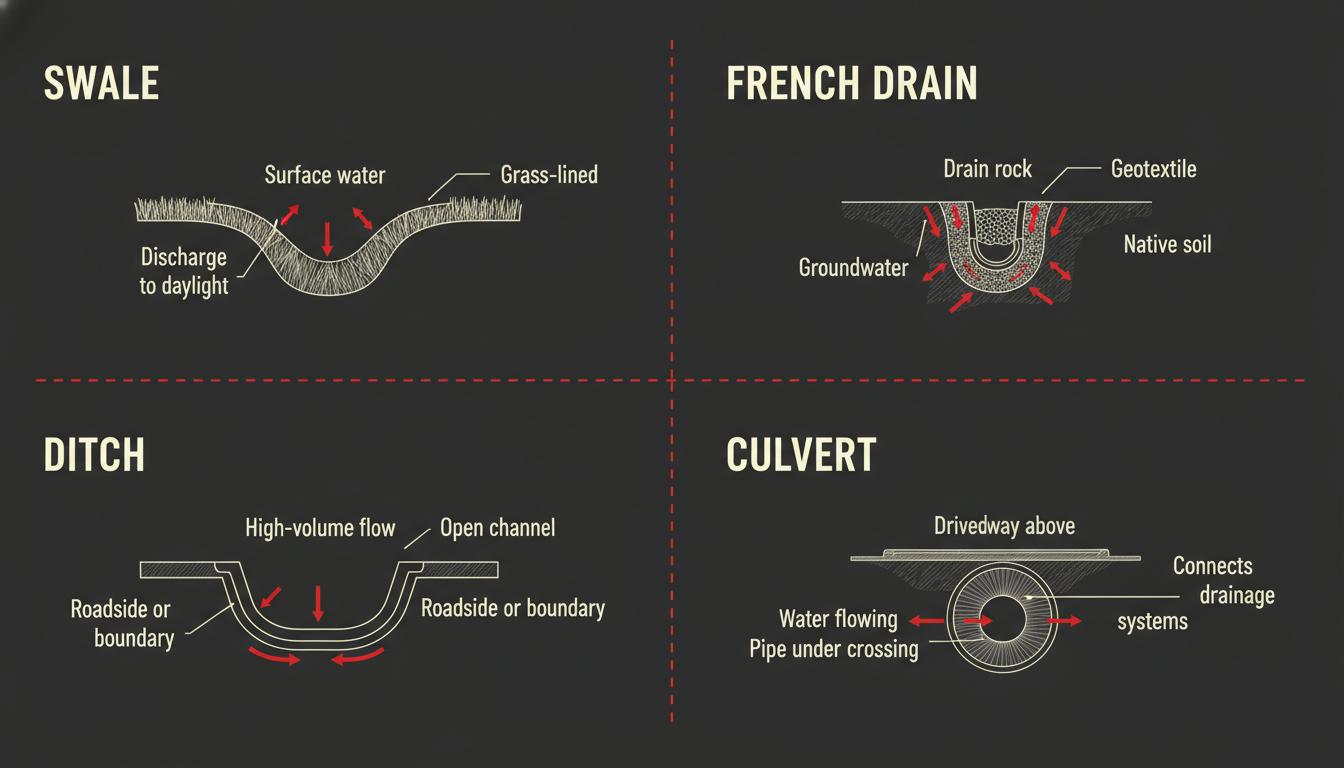
A swale is a shallow grass-lined channel that moves surface water from one place to another. Engineered swales have specific dimensions and slopes. Most rural-residential swales are simpler — a shallow trough cut with a skid steer, sloped just enough to keep water moving, lined with grass that holds the soil and slows the flow.
What swales are good for
- Redirecting surface flow from one part of a property to another — moving water around a building, away from a driveway, off pasture into a discharge.
- Slowing water down on slopes so it infiltrates instead of eroding.
- Pretty solutions — swales blend into landscape much better than visible drainage features.
- Cheap installs — swales are dirt work, no pipe, no fabric, no rock.
What swales aren't good for
- Groundwater problems — a swale on top of saturated ground doesn't help.
- High-volume flow — major roof or driveway runoff overwhelms a typical swale and erodes it.
- Flat properties — swales need at least a small slope (typically 1–2%) to actually move water.
Typical swale cost
$1,200–$2,800 for a typical residential swale (50–200 ft) including discharge prep.
The French drain: groundwater's friend
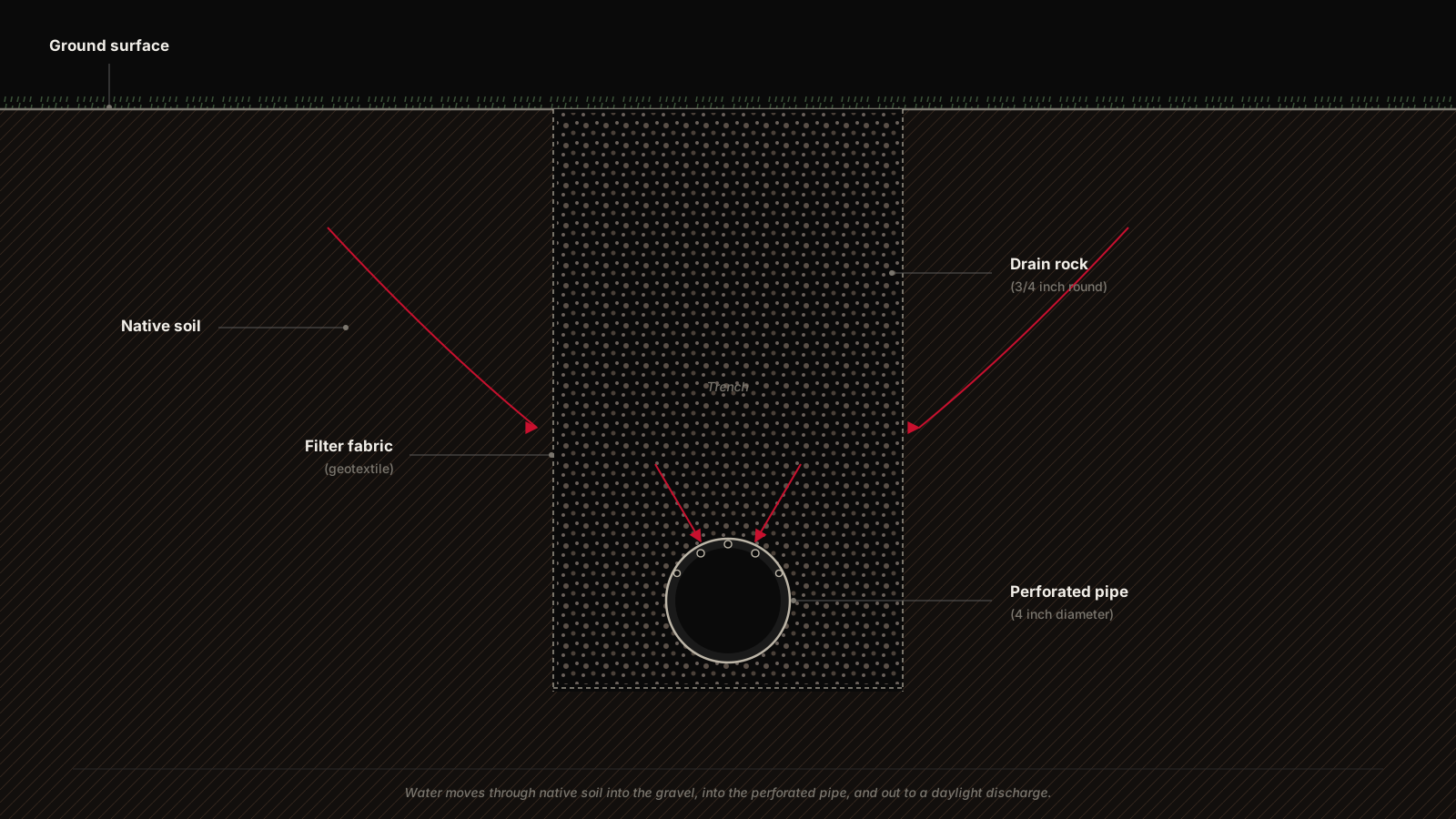
A French drain is a buried perforated pipe in a gravel-filled trench, usually wrapped in geotextile fabric. The pipe collects groundwater that's moving through the surrounding soil and carries it to a discharge point. Properly installed, French drains are nearly invisible from the surface and last for decades.
What French drains are good for
- Sub-surface water — wet basements, soggy crawlspaces, springs, soft spots that stay wet long after rain.
- Foundation protection — a French drain along the uphill side of a foundation intercepts groundwater before it can saturate the wall.
- Building pad protection — installed before pad work, a French drain keeps the pad's base dry.
What French drains aren't good for
- Surface water alone — a French drain catches the water in the soil around the pipe, not the sheet flow on top of the ground. If the problem is surface only, a swale is cheaper and works.
- No daylight discharge — French drains need to discharge somewhere lower than the source. Without daylight (or a sump pump), the pipe just fills up and stops working.
- Cheap construction — a French drain done wrong (no fabric, wrong gravel, no slope to discharge) fails fast. Done right, it's not the cheapest tool.
Common French drain mistakes we see
- No geotextile fabric — soil migrates into the gravel and the pipe silts up within a couple of years.
- Discharge uphill of the source — water can't flow against gravity, the pipe stays full.
- Trench dead-ends with no daylight — pipe acts as a buried bathtub.
- Wrong gravel — fines in the gravel pack the pipe instead of letting water flow through.
Typical French drain cost
$2,000–$5,000 for typical residential installs (50–200 ft), depending on length, depth, and discharge complexity.
The ditch: cheap, simple, ugly, effective
A ditch is just an open channel cut to grade. Bigger than a swale, often unlined, sloped to move significant volume. Most rural Oregon roads have ditches alongside them — that's how road runoff gets handled. Properties often have ditches along boundaries, around fields, behind structures.
What ditches are good for
- High-volume surface flow — what a swale can't handle, a ditch can.
- Property boundary drainage — keeping the neighbor's water off your land or vice versa.
- Field-scale drainage — moving water from large open areas to a discharge.
- Cheap, fast solutions — a ditch is just dirt work; no materials beyond the operator's time.
What ditches aren't good for
- Aesthetics — ditches are visible. Swales hide. French drains disappear.
- Mowing access — a deep ditch is a maintenance headache for anyone running a tractor or mower.
- Sub-surface problems — same limitation as swales.
Typical ditch cost
$500–$2,500 for ditch cleanout or new ditch cuts on rural acreage, depending on length and depth.
The culvert: where systems meet
A culvert is a buried pipe that lets water pass under something — a driveway, a road, a path. Culverts don't drain water themselves; they let drainage systems on either side of an obstacle stay connected. Without a culvert at a driveway entrance, the roadside ditch dead-ends at your drive and floods.
What culverts are good for
- Driveway entrances — letting roadside ditches flow past your drive instead of pooling.
- Crossings within a property — driveway crosses a swale or ditch, you need a culvert.
- Connecting drainage systems — French drain discharge crossing a road, swale crossing a path.
Sizing matters
An undersized culvert (too narrow for the flow that needs to pass) is worse than no culvert — it creates a choke point that floods. Linn County has guidelines for residential entrance culverts, typically 12"–18" diameter for a typical rural drive. A contractor experienced with valley properties can size from observed peak flow.
Typical culvert install cost
$400–$1,200 including pipe, depending on size, length, and access. Often a fast standalone job (half-day work).
The decision tree
Quick framework for picking your drainage tool:
- Surface flow you can see during a storm? Swale (small to medium) or ditch (large).
- Groundwater you can't see but feel — soggy ground, wet basement, soft spots? French drain.
- A driveway crossing a ditch or swale, water pools at the entrance? Culvert.
- Water from another property running onto yours? Boundary swale, ditch, or curtain drain depending on whether it's surface or sub-surface.
- Roof runoff dumping in the wrong place? Gutter extensions and a swale or buried discharge to daylight away from the structure.
The valley reality: most jobs need more than one
Real properties rarely have a single drainage problem. A typical Linn County rural-residential drainage job often combines:
- Cleaning out a clogged roadside ditch.
- Installing or upsizing a driveway culvert.
- Cutting a swale to redirect upslope flow.
- Installing a French drain along a foundation or pad.
Done together as a single dirt-work job, the math is much better than as four separate calls. The operator already knows the property, the equipment is already there, and the system gets designed as a system rather than as four disconnected fixes.
What to ask before signing
- Where will my water go? Every drainage solution needs a discharge. Without one, water just collects somewhere else. A good contractor walks the discharge route as part of the quote.
- Have you actually seen the problem during a storm? Drainage walked dry is half-walked. Drainage walked during or after a storm is the real diagnosis.
- What's the maintenance plan? Ditches and swales need occasional cleanout. Culverts need clearing. French drains are mostly maintenance-free if installed right but should be inspected. Build the maintenance plan into the install conversation.
The bottom line
Drainage isn't one tool — it's four common tools that fit different problems. Swales and ditches handle surface water. French drains handle groundwater. Culverts let systems pass each other without conflict. Most real properties need more than one. The right job is usually a system, designed as a system, by a contractor who walked it during a storm.
If your property has drainage problems and you're not sure which tool fits which spot, see our drainage service page or our driveway-flooding diagnosis post for adjacent context.
Got a drainage problem and not sure what fits?
Walk it during a storm if you can. Send photos. We'll come look and tell you which tool fits.