Shed & RV Pad Installation
in Lebanon, Oregon
Level, compacted gravel pads for sheds, RVs, shops, hot tubs, and outbuildings — sized to what you're putting on top, drained so water sheds, built so it stays level for the long haul. Site visit, quote, and a finished pad in days, not weeks.
Shed & RV Pads
A pad that drains.
A pad that lasts.
Most shed and RV pad failures come down to the same three mistakes: built on ground that holds water, not actually compacted, or made too thin. We do this kind of work weekly across Linn County and the mid-Willamette Valley. The pad we leave is one that won't sink, won't rut, and won't tilt your shed in five years.
What we build pads for
- Sheds & outbuildings — garden sheds, tool sheds, chicken coops, lean-tos, garden buildings.
- RVs & motorhomes — pull-throughs, back-ins, seasonal storage pads, and full-time setups with utility hookups.
- Shops & pole barns — full pad prep where a concrete contractor will later pour a slab, or a builder will erect a pole structure directly on the gravel.
- Hot tubs — small, level pads with proper base and drainage so the tub doesn't shift over time.
- Generator pads, propane tank pads, well-house pads — utility-scale flat surfaces.
- Trailer storage & equipment pads — rural properties with multiple trailers, tractors, or stored vehicles.
How we build a pad
- Walk and stake. Jeff walks the proposed location, looks at how water moves on the lot, checks for soft spots, marks the corners.
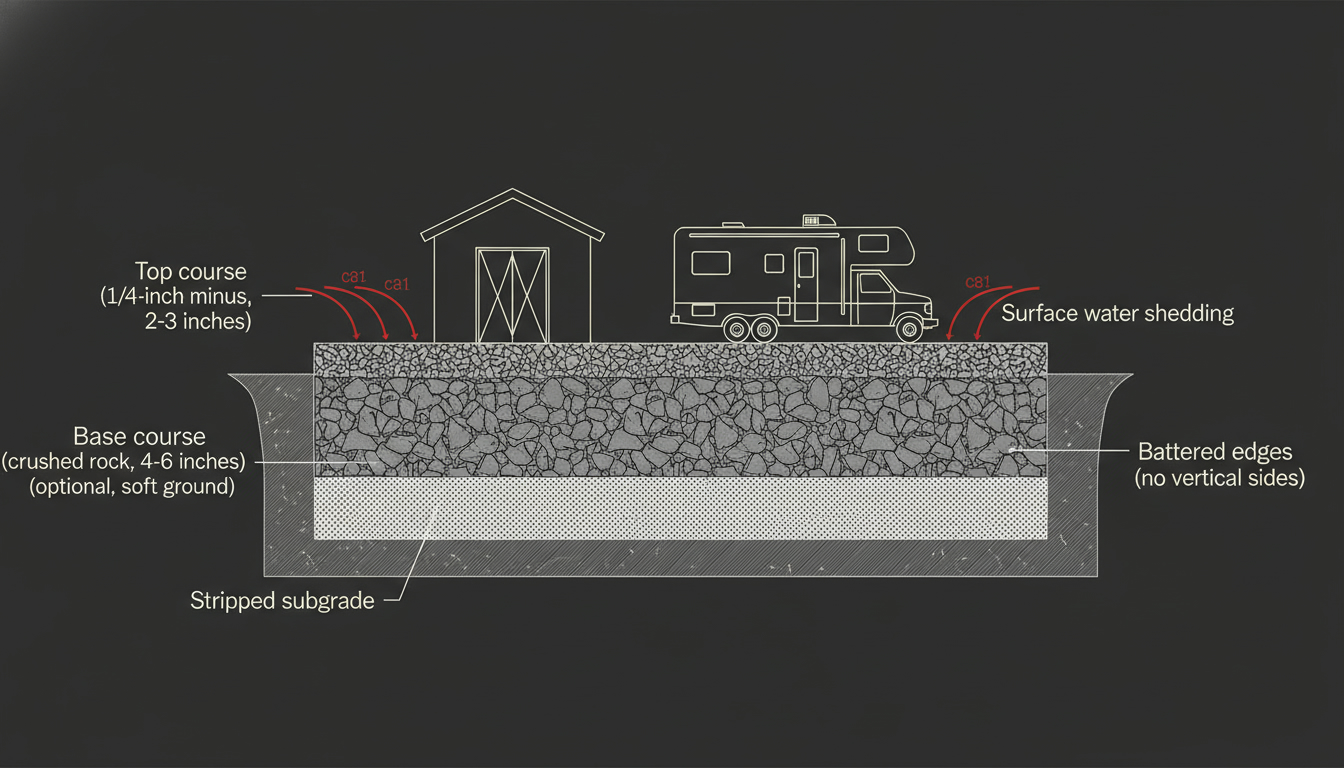
- Strip and grade. Topsoil and organics get stripped (anything organic settles over time). The subgrade is cut to elevation and shaped so water moves off, not under.
- Geotextile (where it earns it). On soft ground, we lay woven geotextile fabric to keep the gravel from migrating into mud. Not always needed — but cheap insurance where the soil's questionable.
- Base course. Crushed rock — typically a 1.5" or 3" base course — placed in lifts and compacted with a vibratory plate.
- Top course. ¾-inch minus on top, compacted in. The minus has fines that lock together and resist rutting.
- Crown and edges. Pad is crowned a slight ¼ inch per foot toward the lower side so water sheds. Edges are battered, not vertical, so the gravel doesn't slough.
Pad sizing
Sheds: match the building footprint plus 6 inches of overhang on all sides. Don't size the pad smaller than the shed thinking it'll hide the edges — water will run off the building straight onto the ground around it and undermine the pad.
RVs: at least 3 feet longer and 3 feet wider than the rig. For a 35-foot motorhome, that's 12'×40' minimum. Add for slide-outs (figure 4 feet on the slide side) and awnings (figure 12 feet on the door side). Bigger is cheaper than re-doing.
Shops: footprint plus 2 feet on each side for working room and water management. If you're doing a concrete slab on top, your contractor will spec the prep dimensions.
What we don't do
We don't pour concrete. If you want a slab, we prep the pad and your concrete contractor pours on it (we coordinate the schedule and the spec). We don't install foundations, tie-downs, or vapor barriers — those are the next contractor's job. And we don't permit the structure — most sheds don't need one in Linn County, but anything over a certain footprint or height does, and that's your general contractor's paperwork.
Pairs naturally with
Pad work fits in a bigger job.
Site Prep
The full version — clearing, cut/fill, drainage, and pad prep for foundations.
DetailsDriveways
Access road to the new shed or RV pad — built right from day one.
DetailsDrainage
Where the lot needs water moved before a pad goes in.
DetailsGrading
Shape the surrounding ground so the pad doesn't sit in a low spot.
DetailsWhere We Work
Shed and RV pad installation in Lebanon and across Linn County.
We build shed pads, RV pads, shop pads, and hot-tub pads in Lebanon, Albany, Corvallis, Salem, Sweet Home, Brownsville, Jefferson, Scio, Tangent, Halsey, Harrisburg, and the rural acreage between them. See the full service area for distances.
- LebanonHome base · Linn County
- Albany~13 mi NW · Linn County
- Corvallis~25 mi W · Benton County
- Salem~30 mi N · Marion County
- Sweet Home~14 mi E · Linn County
- Brownsville~12 mi S · Linn County
- Jefferson~17 mi N · Marion County
- Scio~16 mi NE · Linn County
- Tangent~15 mi W · Linn County
- Halsey~18 mi SW · Linn County
- Harrisburg~25 mi SW · Linn County
FAQ
Common questions about shed and RV pads.
How big should my RV pad be?
Standard rule of thumb: at least 3 feet wider and 3 feet longer than the rig. A 35-ft Class A motorhome wants a 12'×40' minimum. Add room for slide-outs, awning, and side-step. Bigger is always better than smaller — you can't extend a pad easily after it's compacted.
Gravel pad or concrete pad?
Gravel pads cost a fraction of concrete, install in a day, and drain better — they're the right choice for sheds, RVs, and most outbuildings. Concrete is worth it for heated shops where you want a finished floor, garages where you'll be wrenching on cars, or any structure with a code-required slab. We do gravel pads. Your concrete contractor pours on top of our prep.
How thick should the pad be?
For sheds and small structures: 4–6 inches of compacted ¾-inch minus over a graded subgrade. For RV pads: 6–8 inches with a heavier base where soft ground demands it. For shop pads where you'll later pour concrete: spec from your contractor or engineer; typically 4–6 inches of compacted base.
Will it stay level?
Compacted-in-lifts gravel pads on a properly drained subgrade hold up for decades. Where pads fail, it's almost always: built on undrained ground, never compacted, or installed too thin. We do all three correctly. We also crown the surface so water sheds rather than pools.
Not sure which rock or fill to order? See our rock and gravel size guide, with every size compared to a quarter.
Got something coming that needs a pad?
Tell us what's going on the pad — shed model, RV length, shop dimensions. We size it right the first time.