Land Clearing
The first cut.
Usually the first job.
Land clearing is the first call for most of our new customers. Somebody buys a rural property and the back pasture is a solid wall of brush. Somebody's trying to put up a shop and can't even walk the site to stake it. Somebody needs to reduce fire fuel before summer. Whatever the reason, clearing is where most Iron & Earth projects begin — and once we've got a clean site to work with, the next call is usually grading or drainage.
What we clear
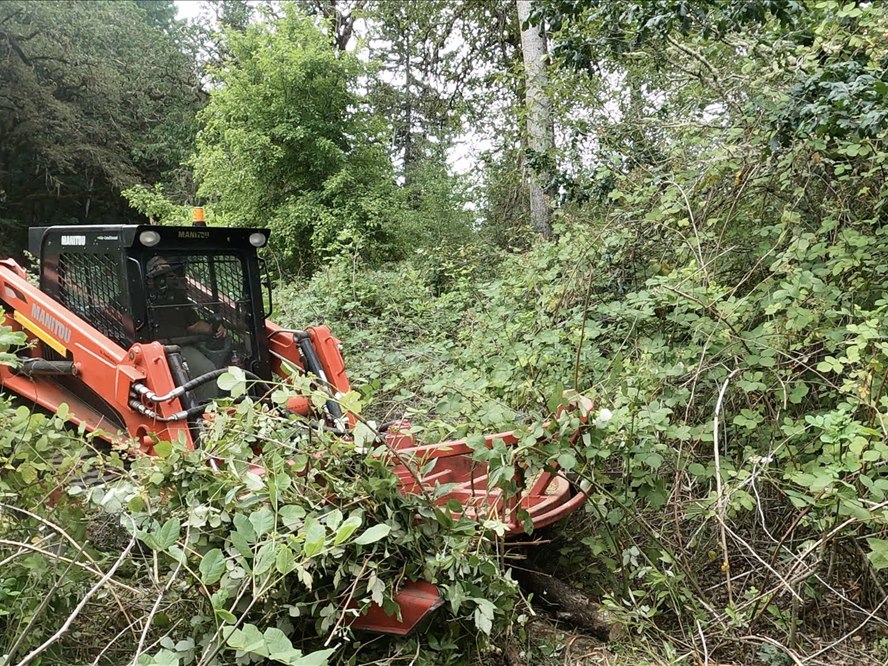
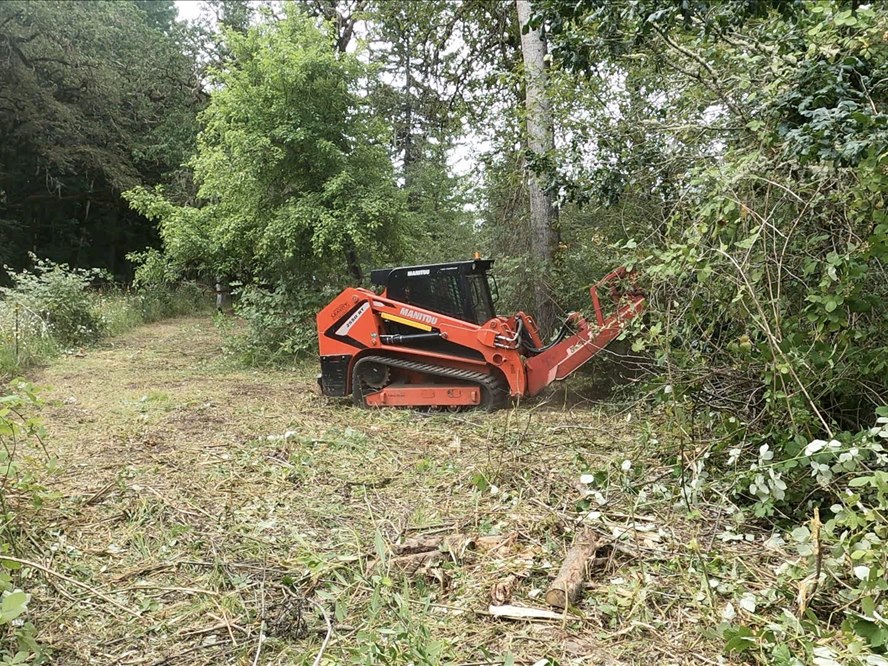
- Blackberry & scotch broom. The valley's two most hated invaders. We mow them flat with the brush cutter — no burn pile, no hand-cutting for a month, no chemicals unless you ask. (For Corvallis-area properties specifically, see our Corvallis blackberry removal page.)
- Small to medium brush and saplings. Anything up to about 3–4 inches in diameter goes through the cutter. Bigger trunks get pulled with the excavator.
- Overgrown pasture and fence lines. Reclaim the acreage you already own.
- Residential lots. Clear a site so a contractor can walk it, survey it, or start building.
- Fire fuel reduction. Create defensible space around structures and clean up ground fuel.
What we don't do
We're not a logging outfit. Timber harvest, commercial log removal, and big-diameter tree felling aren't our business — we'll point you to a licensed timber faller or logger for that. We clear brush, undergrowth, small trees, and get the site ready.
How the job actually goes
For most clearing work, Jeff walks the property first so he can see what's in there — fence lines, stumps, wet spots, slopes, old equipment hidden in the brush. Then we schedule a start date, show up with the machines, and work the lot from the outside in. Debris gets piled where you want it (burn pile, haul-off pile, or chip pile), and we leave the ground walkable and workable.
After the clear
Most customers pair clearing with one or two other services: pulling the stumps that are left, rough-grading the newly cleared ground, or cutting in access roads. We quote all of it as one job so you're not getting billed three times for three separate trips.
See the Work
Watch a job from start to finish.
One acre of blackberries and brush around a pond, cleared in Linn County just outside of Lebanon — skid steer and brush cutter, start to finish.
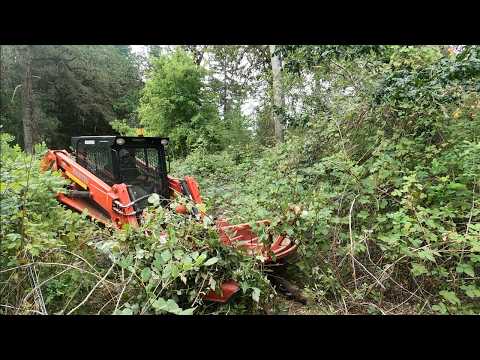
This Pond Had Disappeared Under Blackberries — Linn County, OR · 17 min
Goes well with
Jobs that often pair
with land clearing.
Stump Removal
Once the brush is down, the E50 pulls the stumps the cutter can't touch.
See detailsGrading & Leveling
Rough-grade the newly cleared ground so it's ready for pasture, pad, or drive.
See detailsDriveways
Cut in a new access road to the cleared area — built right from day one.
See detailsWhere We Work
Land clearing in Lebanon and across Linn County.
We provide land clearing in Lebanon, Albany, Corvallis, Salem, Sweet Home, Brownsville, Jefferson, Scio, Tangent, Halsey, Harrisburg, and the rural acreage between them. See the full service area for distances.
- LebanonHome base · Linn County
- Albany~13 mi NW · Linn County
- Corvallis~25 mi W · Benton County
- Salem~30 mi N · Marion County
- Sweet Home~14 mi E · Linn County
- Brownsville~12 mi S · Linn County
- Jefferson~17 mi N · Marion County
- Scio~16 mi NE · Linn County
- Tangent~15 mi W · Linn County
- Halsey~18 mi SW · Linn County
- Harrisburg~25 mi SW · Linn County
FAQ
Common questions about land clearing.
How much does land clearing cost near Lebanon, Oregon?
Most residential land clearing in Linn County runs $1,000–$6,000 depending on acreage and density. A quarter acre of blackberry is typically $1,000–$1,500 (about half a day). A full acre of dense mixed brush and saplings is usually $2,500–$4,000. Steep slopes, thick stumps, and haul-out add cost. See our pricing page for tiered estimates, or call for a quote based on your specific property.
Do I need a permit to clear land in Oregon?
For most residential brush and pasture clearing in Linn County, no permit is required. Exceptions include clearing near a waterway or wetland, clearing large timber on designated forestland, or projects disturbing more than one acre (which may trigger stormwater permit requirements). When in doubt, a quick call to Linn County Planning confirms it for your specific parcel — we can advise based on the site walk too.
Do you serve areas near Lebanon — Albany, Corvallis, Sweet Home?
Yes. We work across a roughly one-hour radius from Lebanon. That covers Lebanon, Albany, Corvallis, Sweet Home, Jefferson, Brownsville, Scio, Tangent, Halsey, Harrisburg, and Salem. If you're in Linn County or the edges of Benton, Marion, or Lane County, we can likely get to you.
How big a lot can you clear in a day?
It depends heavily on density. Wide-open pasture with light brush: half an acre to a full acre per day. Heavy blackberry tangle in tree cover: a fraction of that. We give a realistic estimate after walking the property.
Do you haul off the brush or burn it?
Either. We can stack debris in burn piles where you want them, leave it as in-place mulch from the brush cutter, or haul it out as a separate add-on. Most rural customers go with burn piles or in-place mulch — haul-out is the most expensive option.
Do you take the stumps out too?
Land clearing is brush, undergrowth, and small saplings. Stumps are a separate pass with the excavator — usually quoted as part of the same job, but a distinct line item. See stump removal for details.
When's the best time of year to clear?
Late winter to early summer is the sweet spot. Brush is wet enough to cut clean, the ground is firm but not frozen, and the work is done before fire season opens. Fall works too if the ground hasn't saturated yet.