Stump removal —
when to grind, when to pull, when to leave alone.
By Jeff Walters · April 28, 2026 · 7 min read
People call about stumps with their mind already made up — "I need it ground out." Sometimes that's right. Sometimes pulling is faster and cheaper. Sometimes leaving the stump alone for a couple of years is the smartest call. Here's the honest framework for picking the right approach for your stump.
The three options
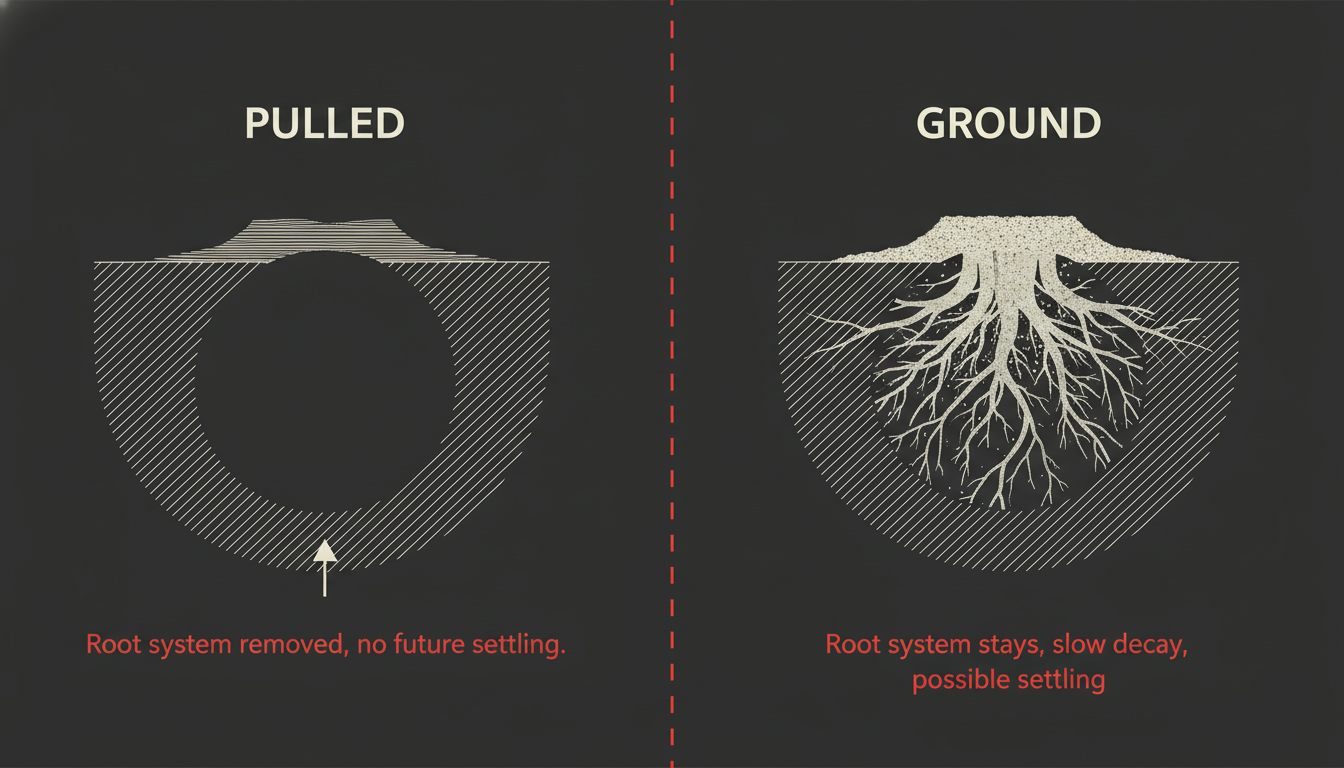
Three things you can do with a stump:
- Grind it. A stump grinder chips the wood down to roughly 6–12 inches below grade, leaving a hole filled with chips that you backfill or amend.
- Pull it. An excavator with a thumb attachment rips the stump and root ball out of the ground, leaving a hole that gets backfilled and tamped.
- Leave it. Cut flush, let the wood and roots decay over years. Sometimes the right answer.
None of these is universally best. The right choice depends on what's around the stump, what you need the ground to do next, and how much you want to spend.
Grinding: what it's good for
Stump grinders are dedicated machines that chew wood with a rotating cutting wheel. Tree services typically own them. They produce a hole filled with wood chips and the root system stays in the ground, slowly decaying over years.
When grinding is the right call
- The stump is in a finished lawn or landscaped area you don't want to disturb. Grinding leaves a small hole; pulling tears up a much wider area.
- The stump is near a paved driveway, sidewalk, foundation, or hardscape. Pulling close to hardscape risks cracking the surface as the root ball comes out.
- You're not going to disturb the ground anyway. If the lot's not getting graded or built on, grinding is sufficient.
- The stump is small enough to grind economically. Big stumps take a lot of grinder time and the cost adds up.
What grinding doesn't fix
- The roots stay in the ground. They decay over years, leaving gradually softer soil — which can cause settling if you build on top of where they were.
- Sucker growth. Some species (poplar, willow, cherry, locust) sucker from the root system after grinding. The visible sucker is a young tree growing from the old root mass.
- The grindings themselves. The hole fills with wood chips, which are not soil — they have to be amended or replaced if you want to plant or build over the spot.
Pulling: what it's good for
An excavator with a thumb attachment grabs the stump and rips it out of the ground, root ball and all. We do this with a Bobcat E50 mini excavator. The result is a hole roughly the size of the root system (a few feet across for residential stumps), which gets backfilled with the surrounding soil and tamped down.
When pulling is the right call
- The ground is going to be regraded anyway. If clearing or pad work is happening on the lot, pulling stumps doesn't add disturbance — it removes them once and for all.
- The stump is in pasture or open ground where minor disturbance doesn't matter. The hole gets backfilled and grass grows over it within a season.
- The stump is too big or too tough for grinding economics to work. Some species (oak, locust, walnut) have hardwood that grinders chew slowly. For big stumps, an excavator finishes in 5 minutes what would take a grinder 30+.
- You want the root system gone, not just the stump. No future settling. No sucker regrowth from buried roots.
- You want it done in volume. Pulling 20 stumps after a clearing job is faster and cheaper than grinding 20 stumps.
What pulling doesn't fit
- Lawns or landscaped areas. The disturbed area is much bigger than the stump itself. If the surrounding grass is precious, grinding is the right call.
- Stumps right next to hardscape. Pulling can crack adjacent slabs, sidewalks, or foundation walls.
- Stumps over about 24" diameter. Our E50 handles up to ~18" cleanly, sometimes 24" with patience. Larger than that and you want a heavier excavator or a tree service to fell and section first.
- Tight access where the excavator can't reach. Backyards with no gate access bigger than 4 feet, dense suburban lots — grinding wins because the grinder is more compact.
Leaving alone: the underrated third option
If a stump is in pasture, in a back corner you don't visit, in woods you're not developing — sometimes the smartest call is to do nothing for a few years. Stumps decay on their own. Soft hardwoods (alder, cottonwood, willow) decay in 3–5 years. Harder species (oak, locust) take longer but eventually go too.
When leaving alone is right
- The stump is in pasture you mow over (or graze around). Cut flush, let nature take its course.
- You don't need to use the spot for anything in the next 5+ years. Decay is free; intervention costs money.
- The stump is in a wooded area you're not actively managing. Wildlife habitat, soil organisms, fungal networks — leaving stumps is ecologically valuable.
- Cost is a real constraint. Free is hard to beat if you have time.
When leaving alone fails
- The stump is in active construction or grading territory. It has to come out before any pad or driveway work.
- Sucker species. Some trees keep growing from the stump indefinitely if cut and left. They become ongoing maintenance.
- Aesthetic / safety. Stumps in mowing zones get hit by mowers. Stumps near walkways become trip hazards. Some yards just want them gone.
The cost comparison (typical Linn County 2026)
- Grinding a single residential stump (10–18" diameter): $150–$350.
- Grinding a large stump (18–30" diameter): $300–$600.
- Pulling a single stump after clearing: $200–$400.
- Pulling stumps in volume after a clearing job: $50–$150 per stump (significantly cheaper than grinding at volume).
- Leaving alone: $0, plus the cost of any future workaround (mowing around, etc.).
Grinding has lower fixed cost for a single small stump. Pulling has lower per-stump cost in volume. The crossover is usually around 3–4 stumps — below that, grinding is cheaper; above that, pulling is.
The decision tree
Quick framework for picking your method:
- Is the stump in a finished lawn or near hardscape, and the lot's not getting redone? → Grind.
- Is the lot getting cleared, graded, or built on? → Pull as part of that job.
- Is it a single stump in pasture or low-priority area, and you don't need the ground for anything for years? → Leave alone.
- Is it a big or hardwood stump that grinders struggle with? → Pull.
- Is access tight (can't get an excavator in)? → Grind.
Why we pull and don't grind
For full transparency: Iron & Earth pulls stumps with the excavator. We don't grind. That's not because grinding is wrong — it's because the customer base we serve is mostly rural-residential property owners with multiple stumps, larger acreage, and lots being graded for use. For our typical job, pulling fits. If your stump is in a finished lawn near a foundation, we'd refer you to a stump grinding service rather than try to make pulling fit something it doesn't.
This is the pattern across the rural Willamette Valley. Tree services own the grinders. Excavation contractors do the pulling. Both have a place — and the right contractor tells you straight which one fits your job.
The bottom line
Stump removal isn't one method. It's three options, and the right one is determined by what's around the stump, what the lot will be used for, and what the broader project context is. The cheap answer for a single stump in a lawn is grinding. The cheap answer for 20 stumps after clearing is pulling. The cheap answer for a stump in the back forty might be doing nothing at all.
If you've got stumps and aren't sure which approach fits, see our stump removal service page or call — we'll walk the property and tell you straight whether pulling fits or whether you want a grinder.
Got stumps?
Send a photo and rough count. We'll tell you straight whether pulling, grinding, or leaving alone makes sense.