Defensible space in western Oregon —
what ODF and your insurance actually require.
By Jeff Walters · April 28, 2026 · 9 min read
Defensible space wasn't really a Linn County conversation a decade ago. It is now. The 2020 Labor Day fires changed how western Oregon thinks about wildfire, and SB 762 changed what's required by law. Insurance carriers added their own questions on top. Here's what's actually in those rules and what they translate to as actual dirt work on a property.
What defensible space actually means
Defensible space is the area immediately around a structure where vegetation has been managed to slow, redirect, or interrupt wildfire — and to give firefighters a place to operate from. It's not a single zone but three, with progressively less aggressive treatment as you move away from the building.
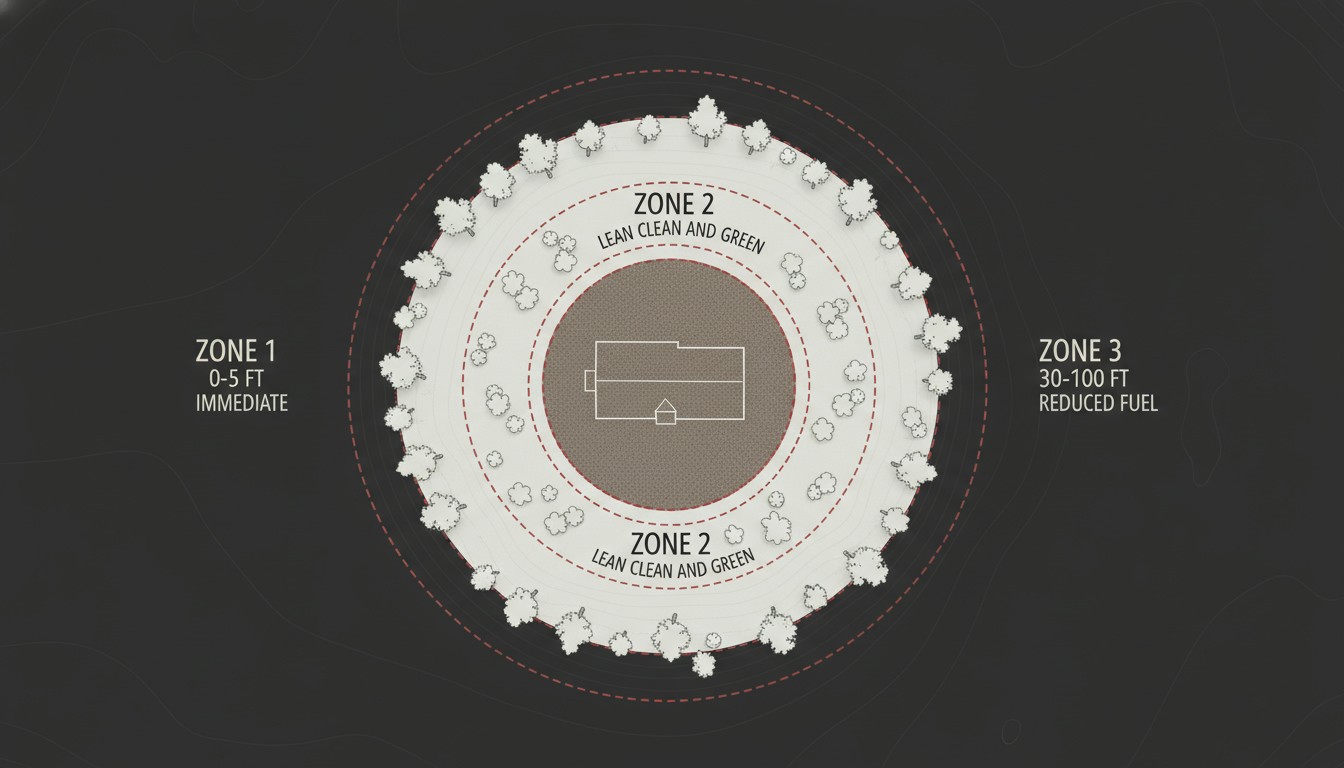
Zone 1: 0–5 feet from the structure (immediate)
This is the closest, hottest, most consequential zone. The current Oregon Defensible Space Code recommends:
- No combustible material against the structure — no firewood stacked against the wall, no gas tanks within 5 feet, no flammable mulch like bark in this band.
- Hardscape preferred — gravel, concrete, pavers, bare mineral soil.
- If plants are kept here, they should be low, sparse, well-irrigated, and pruned away from siding, eaves, and decks.
- Roof and gutters kept clear of needles and leaves.
Zone 2: 5–30 feet from the structure (lean, clean, and green)
This is where most property owners actually do work. The goal is a "lean, clean, and green" landscape:
- Lawns mowed short, especially during fire season.
- Shrubs spaced apart so fire can't carry from one to the next.
- Tree canopy thinned so branches aren't touching each other or the structure — typically 10-foot horizontal separation between mature trees.
- Branches limbed up at least 6–10 feet from the ground (no "ladder fuels" letting ground fire climb into the canopy).
- Dead branches, dead trees, and dry debris removed.
- Firewood, propane tanks, and combustible storage moved out of this zone or to its outer edge.
Zone 3: 30–100 feet from the structure (reduced fuel)
The outer ring. Less aggressive than Zone 2 but still managed:
- Brush and undergrowth thinned but not necessarily removed.
- Tree canopy thinned where dense.
- Dead and downed wood reduced.
- Surface fuels (tall grass, brush) cut back, especially on slopes (where fire moves uphill fast).
What changed in Oregon
SB 762, passed in 2021, is Oregon's wildfire response law. It directed the Oregon Department of Forestry (ODF) to map wildfire hazard zones across the state, and authorized the Oregon State Fire Marshal to set defensible space and home hardening standards in the highest-risk areas.
The implementation has been politically rocky — the original 2022 ODF hazard map was withdrawn after public pushback, and a revised version is in process. As of 2026, the practical situation in western Oregon is:
- Defensible space recommendations exist statewide.
- Mandatory requirements apply to properties in mapped "high" or "extreme" wildfire hazard zones.
- A lot of Linn County and the eastern Willamette Valley sits in moderate-to-high zones, depending on the parcel's slope, vegetation, and proximity to wildland.
- Owners can check their property's hazard rating on ODF's online map (search "Oregon wildfire risk explorer").
Whether your property is currently required to maintain defensible space is determined by that map. But increasingly, even properties not in the highest zones are being treated as if they should — by insurance carriers, by mortgage underwriters, by future buyers.
What insurance carriers actually ask
If you've renewed homeowner insurance on a rural Oregon property in the last few years, you've probably noticed new questions:
- "Is the structure within X feet of brush, trees, or wildland?"
- "Has defensible space been maintained around the structure?"
- "What is the wildfire hazard rating of the parcel?"
- Some carriers send aerial imagery review and flag specific parcels for vegetation issues.
Carriers vary widely in how they use this information. Some offer premium discounts for verified defensible space. Some non-renew policies on parcels they consider too high-risk regardless of mitigation. Some are using IBHS Wildfire Prepared Home certification (a third-party standard) as a way to qualify properties for coverage that would otherwise be unavailable.
What this means practically: document everything. If you do defensible space work, take before/after photos, get the contractor's written invoice describing the scope, and keep that file. When your renewal questionnaire shows up, you have evidence.
Translating recommendations into dirt-work
What does "thin Zone 2 vegetation" or "create a Zone 3 firebreak" actually mean as a job on the ground? Here's the rough translation:
Brush mowing
Most western Oregon properties have invasive brush — Himalayan blackberry, scotch broom, salmonberry, scrub — building up in Zones 2 and 3. The single most impactful defensible-space dirt-work is cutting all of that back with a skid-steer brush cutter. One pass turns a wall of fuel into a mowed-stubble surface.
Property-line firebreak
A cleared strip along the property boundary — typically 10–30 feet wide depending on slope and surrounding fuel — gives crews and engines something to work with if a fire reaches your line. See our firebreaks page for what this looks like operationally.
Driveway and access widening
Fire engines need wide, clear, drivable access. Many rural driveways have brush growing into the corridor that's fine for a Subaru but won't pass a Type 6 engine. Widening and clearing the driveway corridor — out to the recommended 20-foot horizontal clearance and 13.5-foot vertical clearance — is a frequently overlooked piece of defensible space work.
Ladder-fuel removal
Brush growing under tree canopy lets ground fire climb into the crowns. Cutting out the under-story brush — without removing the trees themselves — is a specific brush-clearing pass that addresses this. Especially important around homes near wooded edges.
Yearly maintenance
Defensible space isn't a one-shot. Brush regrows. The first cut is the heavy lift; a yearly return-pass keeps the cleared zones cleared. Most defensible-space customers move into land management after the initial work.
What it costs
Real numbers for typical Linn County defensible-space dirt-work in 2026:
- Initial Zone 2/3 brush clearing on small acreage (¼–½ acre defended area): $1,500–$3,000.
- Property-line firebreak, modest length (200–400 ft): $1,000–$2,500.
- Driveway corridor clearing (200–500 ft): $800–$2,000.
- Yearly maintenance return-cut on previously-cleared property: typically 30–50% of initial cost.
- Combined initial + first-year maintenance plan, mid-acreage property: $3,500–$7,500.
Where insurance is involved, those numbers often pay for themselves over a few years through retained coverage and (sometimes) modest premium reductions.
Where to start
Three steps for any owner trying to figure out where they stand:
- Look up your property's wildfire hazard rating on the Oregon wildfire risk explorer. This tells you whether you're in a "be aware" zone or a "this is required" zone.
- Walk your property with the three-zone framework in mind. Take photos. Note what's in Zone 1 (immediate), Zone 2 (lean/clean/green), and Zone 3 (reduced fuel). Identify the gaps.
- Get a walkthrough quote from a dirt-work contractor for the heavy mechanical work — brush clearing, firebreaks, access — and a separate plan for the hand-work (siding, gutters, decks, garden) that's the homeowner's domain.
The mechanical side of defensible space — the brush, the firebreaks, the access work — is exactly what we do across Linn County and the mid-Willamette Valley. See our firebreaks & fuel reduction page for the service-page version, or call to schedule a property walk before the next fire season opens.
Related
More from the job site.
Want to be ready before fire season?
March and April are the right window. Call to get on the schedule before the calendar tightens.