Brush after clearing:
burn, mulch or haul?
Iron & Earth Site Services · October 20, 2026 · 6 min read
The brush is down. Now there is a lot of it. In Linn County you can burn it only in certain weeks, on certain days, and only if it is the right material. Here are the three choices, what each one costs, and the burn rules we found.
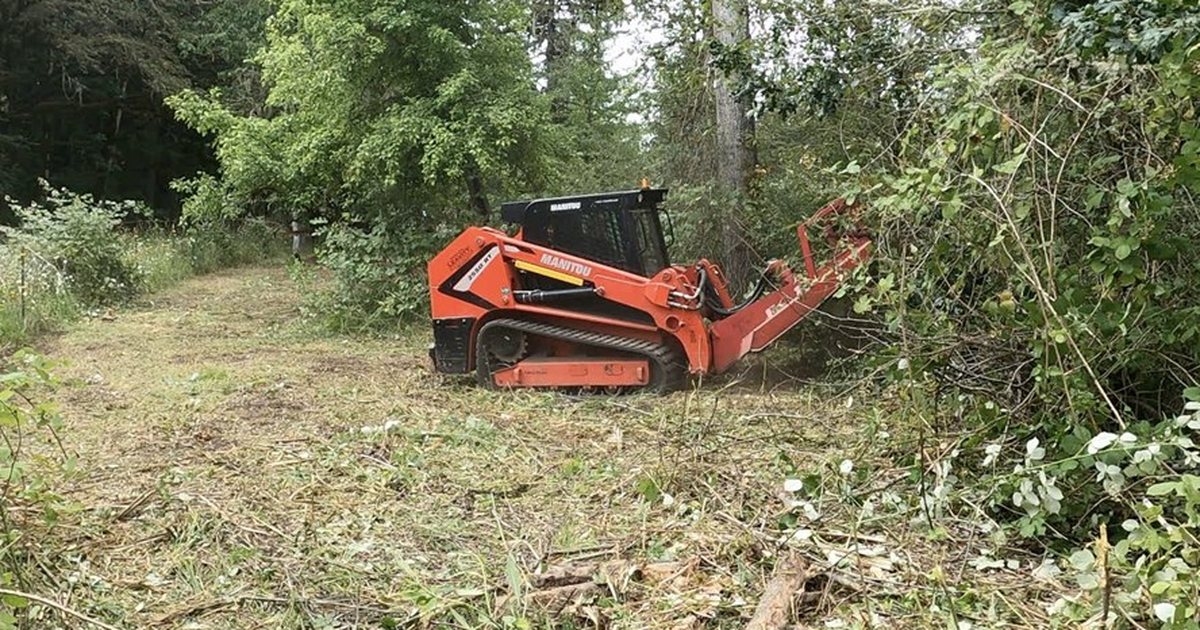
- Mulching in place is the usual choice. It is the cheapest, makes no smoke and carries no fire risk.
- Burning is allowed only in the spring and fall burn seasons, only for plants that grew on your property, and only on days the Linn County Burn Line says yes: 541-451-1904.
- Hauling it away costs the most and is priced as its own line.
- Cleared this fall? Fresh green piles rarely burn cleanly before the fall season ends on December 15. Mulch it, or stack it and burn in spring.
On this page
The three choices
Every clearing job ends with a pile, a layer of mulch or a truckload. Here is how the three compare.
Mulch in place
- Best when
- The job is blackberry, brush, saplings and limbs the brush cutter can chew through, and you want the ground left alone.
- What you get
- A few inches of stubble and a layer of mulched canes that break down over a season.
- Cost
- Included in the clearing price.
- Watch for
- Trunks and big logs do not mulch, so they get set aside or piled. Blackberry grows back from the roots, so plan a second cut the next spring.
Burn it
- Best when
- There is a lot of woody material, or logs too big to mulch, and you have the room and the right days.
- What you get
- Ash and a burn scar. No disposal fee.
- Cost
- We stack debris into piles where you want them. You do the burning. Moving a lot of debris to one spot takes machine time, so it is quoted.
- Watch for
- Season dates, the daily burn line, distance from buildings, smoke, and the fact that any fire you start is yours.
Haul it away
- Best when
- There is no safe place to burn, the lot is tight, or you want it gone.
- What you get
- Debris loaded and taken to a disposal site.
- Cost
- A separate line on the quote. On our jobs it typically adds $500 to $1,500, depending on volume and how far the disposal site is.
- Watch for
- Disposal sites set their own hours and fees. Ask which ones take brush.
Linn County burn rules in plain English
Checked October 20, 2026 against local fire district pages. Dates and rules change, so call before you light anything.
- Seasons. Generally March 1 to June 15 and October 1 to December 15. Your fire district can delay the start or close the season early when it is dry. Outside the seasons, backyard burning is not allowed.
- Check every day. Call the Linn County Burn Line, 541-451-1904, the morning you plan to burn. It is an automated message, updated daily. A no day is a no, even in season.
- What you can burn. Plants that grew on your own property: brush, limbs, leaves. Never trash, construction or demolition material, plastic, rubber or tires, petroleum products, asphalt or animal remains, and nothing that makes dense smoke.
- Distance from buildings. A pile bigger than about 3 feet across and 2 feet high must be at least 50 feet from any structure. Smaller piles need 25 feet. A metal burn barrel needs 15 feet.
- Big piles. Clearing piles are usually bigger than that. If a pile is larger than a person, or you have several, call your fire chief first and talk through a burn plan.
- On the day. Skip hot, dry or windy days. Clear a ring of bare soil around the pile, keep a charged hose or water and a shovel handy, stay until it is cold to the touch, and never use gas or diesel to start it.
- Forestry overlap area. Some properties, generally south of Highway 226 and east of Richardson’s Gap near Scio, fall under the Oregon Department of Forestry, which can have stricter rules.
- City and farm rules differ. Inside a city or urban growth boundary the rules can be stricter, or burning may not be allowed. Burning farm waste from a farm business goes through the Oregon Department of Agriculture (Grower Hotline 503-986-4755).
- The fire is yours. You are responsible for any fire you start and for the damage it does.
Who to call with questions:
- Lebanon Fire District, Fire & Life Safety: 541-451-1901
- Tangent Rural Fire District: 541-928-8722
- Brownsville Rural Fire District: 541-466-5227
- Scio Fire District chief: 503-394-3000
Cleared this fall? Plan the burn for spring
If a job wraps up in October or November, the piles are green and wet. Fresh green brush smokes heavily, and dense smoke is not allowed, so a pile stacked this week often will not burn cleanly before the fall season closes on December 15. You have two good options:
- Mulch it and skip the pile.
- Stack it loosely, away from trees, fences and buildings. Let it dry, then burn it in the spring season (March 1 to June 15) on a day the burn line allows.
Tell us where you want piles when we quote the job.
What about summer?
Debris burning is off between the seasons, and fire season adds limits on running brush cutters and other power equipment in dry vegetation. We plan work around those limits.
A note on blackberry
Mulching clears the top growth of Himalayan blackberry, but the roots survive. Oregon State University Extension says removing a large patch can take several years and needs a check every year for new seedlings. Plan a second cut the next spring. More on that in why fall is a good time to clear blackberry.
What it costs
Brush clearing starts at $1,000 for up to a quarter acre in a day (see pricing), and mulching in place is part of that. Hauling is extra. Ask for the job priced the way you want the brush handled, and ask for a second price if you want to compare. More on how clearing is priced in land clearing cost in Lebanon, Oregon.
Common questions
Can I burn brush piles in Linn County?
Yes, but only in the spring (generally March 1 to June 15) and fall (generally October 1 to December 15) burn seasons, only for plant material from your own property, and only on days the Linn County Burn Line (541-451-1904) says burning is allowed. Fire districts can delay or end a season early, and cities and some areas have extra rules.
What can’t I burn?
Trash, construction or demolition material, plastic, rubber and tires, petroleum products, asphalt, animal remains, and anything that makes dense smoke. Burning is for plants that grew on your own property.
Does mulching get rid of the blackberry?
It clears the top growth and leaves a layer of mulch. Blackberry regrows from the roots, so plan a second cut the next spring and a check for new seedlings every year.
How much does hauling brush away cost?
It is a separate line on the quote. On our jobs it typically adds $500 to $1,500, depending on how much there is and how far the disposal site is. Mulching in place is included in the clearing price.
Sources
Checked October 20, 2026. Rules and phone numbers change, so confirm with the agency before you act.
Related
More from the job site.
Planning a clearing job?
Tell us how you want the brush handled: mulched, stacked for burning or hauled. We will price it that way.