Septic excavation —
what to expect on install day.
By Jeff Walters · April 28, 2026 · 7 min read
Most septic systems get installed on rural property in this order: the licensed septic installer designs and permits the system, then calls a dirt-work operator to dig the hole, then comes back and drops the tank and lays out the drain field. As the property owner, you're hiring two contractors, and there's an art to making them coordinate cleanly. Here's how it actually goes.
Two contractors, two licenses
In Oregon, installing a septic system requires a separate license — the Oregon Department of Environmental Quality (DEQ) regulates onsite wastewater systems and only licensed installers can permit, install, or modify them. The dirt work — digging the tank pit and the drain-field trenches — is straightforward excavation that most CCB-licensed contractors can do. So a typical install pulls in two trades:
- The licensed septic installer designs the system, pulls the permit, sources the tank, runs the lines, fills the system, hits required inspections, signs off the work for the county/DEQ.
- The excavation contractor digs the tank pit to spec, trenches the drain field to spec, often handles backfill and site restoration after.
You can hire one outfit that does both — some septic installers have their own equipment. But just as often, the installer subs out the dirt work to a separate excavation contractor who specializes in it.
What the dirt-work side actually involves
The tank pit
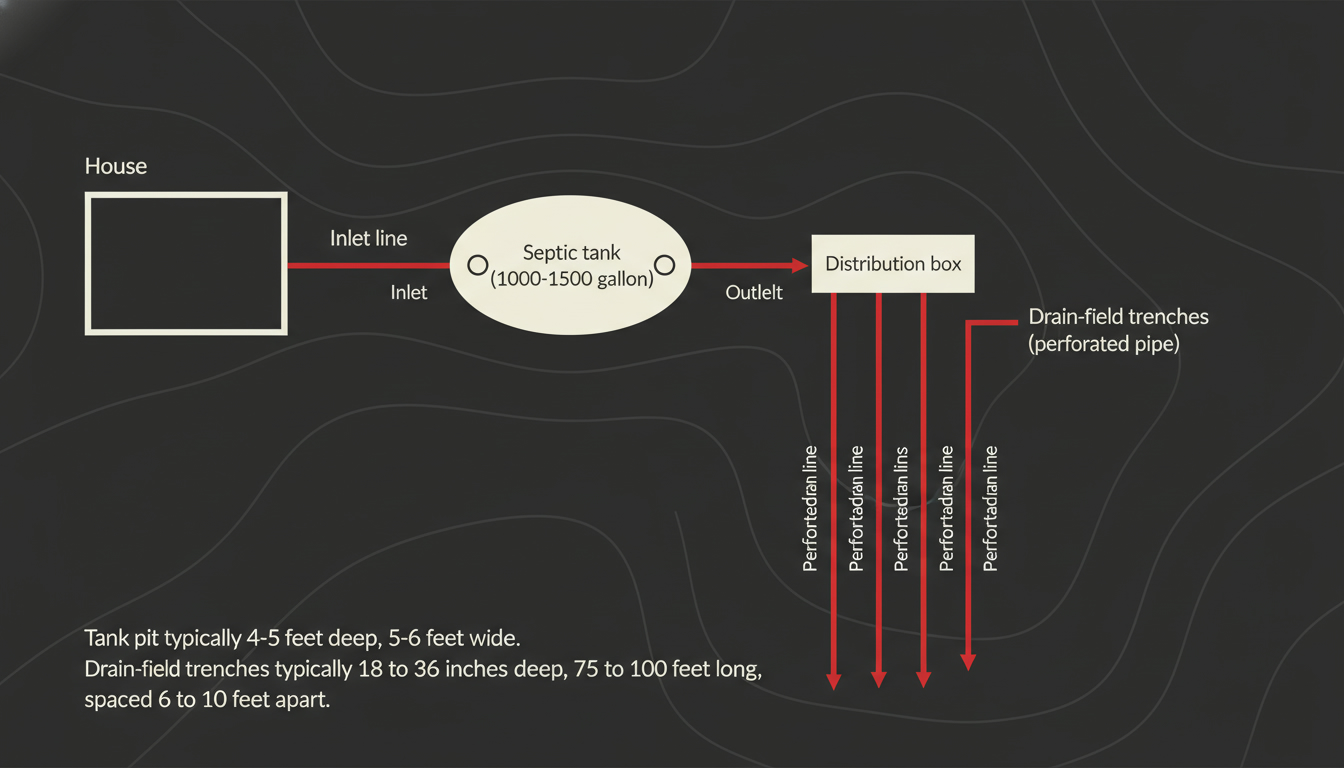
A typical residential septic tank — 1,000 to 1,500 gallons in concrete or fiberglass — needs a pit roughly 4–5 feet deep, 5–6 feet wide, 9–12 feet long, depending on the tank dimensions. Specifications come from the installer's design and the DEQ permit.
The pit needs to be dug to exact elevation. Too shallow and the tank sits proud (concrete tank caps need to be at or near grade for service access). Too deep and the inlet/outlet lines from the house won't have proper slope to the tank. Excavators experienced with septic work get this within a half-inch of spec without much fuss.
Drain-field trenches
The drain field — the buried perforated pipe that distributes effluent into the soil — gets installed in trenches typically 18"–36" deep depending on the system type. Length and number of trenches are spec'd by the installer; for a typical 3-bedroom residential system in standard soil, you're looking at 3–5 trenches of 75–100 feet each.
Trenches need to be cut to grade — slight, even slope along their length, no high spots. Spacing between trenches is also spec'd; too close and they interfere with each other.
Connector trenches
The line from the house to the tank, the line from the tank to the distribution box, and the lines from the distribution box to the drain-field trenches all need their own narrow trenches. These are typically 18"–24" deep, with consistent slope.
The coordination dance
Here's where most projects either run smoothly or hit problems: the timing between excavator and installer.
Best case
The installer calls a few days ahead, gives the excavator the system layout, the depth specs, and the install date. The excavator digs the morning of (or the afternoon before, if soil's stable). The installer arrives midday with the tank on a truck, drops it into the pit, lays the lines, fills the system. Inspector arrives at the agreed time. Excavator backfills after sign-off.
Total active time: usually a single day for the dirt work, a single day for the install, sometimes overlapping.
Common coordination failures
- Hole dug too early — sits open through a rainstorm, fills with water, sides cave, has to be re-dug.
- Wrong specs communicated — pit is too shallow, too narrow, in the wrong place. Installer arrives, can't drop the tank, day is lost.
- No utility locates done — excavator hits a buried line because nobody called 811.
- Backfill happens before inspection — DEQ inspector won't sign off without seeing the open trenches. The whole drain field has to be re-exposed.
- Schedule slip — installer changes the install date, excavator's already committed elsewhere, system sits open or gets pushed two weeks.
What you (the property owner) should do
- Make sure your installer and excavator talk before install day. Ideally a phone call or site visit where the installer shows the excavator exactly where the system goes, what depth, what spec.
- Confirm 811 has been called. Oregon requires 2 business days of locate notice. Either the excavator or the installer should be confirming this before any digging starts.
- Be on site (or reachable) install day. Decisions sometimes need a property owner — where to stage the tank, whether a particular tree comes out, where the access route runs.
- Confirm inspection is scheduled. Most counties require an open-trench inspection before backfill. Your installer schedules this. Confirm it's on the calendar before backfill happens.
- Get the as-built diagram after the install. You'll want it the next time you do anything in the back yard — landscaping, pond, shed, driveway extension.
Old tank removal
For many rural valley properties, a new septic install is actually a replacement install. The old tank needs to come out (or in some cases, be decommissioned in place per DEQ rules). The dirt-work side of removal:
- Locate the old tank — usually in the property records, sometimes via probing.
- Excavate around it, expose the lid.
- Pump the tank empty (a pumper service handles this — the excavator usually doesn't pump).
- Pull the tank with the excavator, or break it up in place if it's degraded concrete.
- Backfill the void.
Old tank removal is its own line item on top of the new install. Decommissioning paperwork goes to the licensed installer.
What it costs
Real numbers for the dirt-work portion of a typical Linn County residential septic install in 2026 (the installer's fees, tank, materials, and permits are separate):
- Tank pit dig: $400–$800 depending on depth and access.
- Drain-field trenches (3–5 trenches, 75–100 ft each): $1,500–$3,500 depending on length and number.
- Connector trenches (house to tank, tank to D-box, D-box to field): $400–$1,000 depending on layout.
- Backfill and site restoration: $500–$1,500 depending on volume.
- Old tank removal (if applicable): $800–$2,000 depending on tank type and access.
Most full-replacement septic dirt-work jobs in our service area land between $3,500 and $7,000 for the excavation portion. The installer's portion of the bill is typically in addition — covering tank, parts, permits, design, inspection coordination, and labor.
The bottom line
Septic excavation is straightforward dirt work executed against tight specs and a tighter schedule. The installer drives the design and the calendar; the excavator delivers the holes on time, on spec, and stays out of the way of the install. Done well, the two trades hand off cleanly and the system's in the ground in two days. Done poorly, you've got cave-ins, schedule slips, and a re-inspection.
Across Linn County and the mid-Willamette Valley, we work with multiple licensed septic installers — happy to coordinate with whoever you've already hired, or recommend installers we know if you don't have one. See our septic excavation service page or request a walkthrough.
Septic project lined up?
Tell us your installer and timeline. We'll coordinate the dirt-work side directly with them.